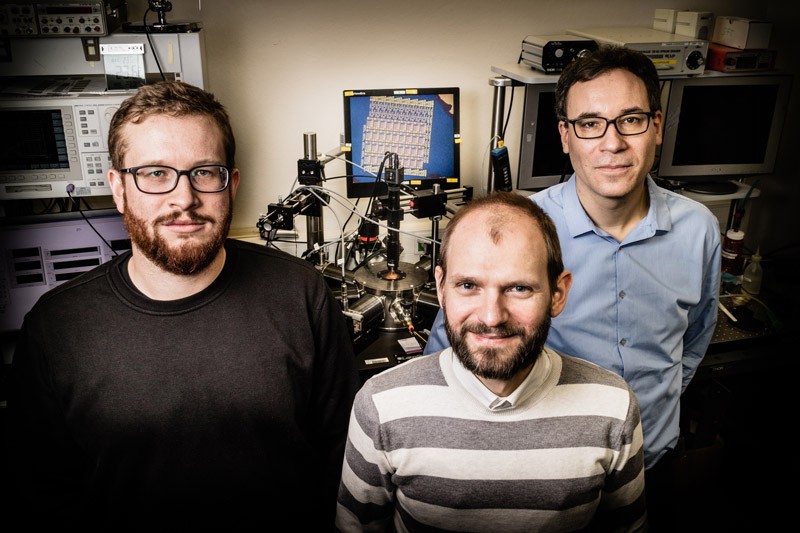
Stefan Wachter, Dmitry K. Polyushkin und Thomas Müller
Two-dimensional materials, or 2D materials for short, are extremely versatile, although - or often more precisely because - they are made up of just one or a few layers of atoms. Graphene is the best-known 2D material. Molybdenum disulphide (a layer consisting of molybdenum and sulphur atoms that is three-atoms thick) also falls in this category, although, unlike graphene, it has semiconductor properties. With his team, Dr Thomas Mueller from the Photonics Institute at TU Wien is conducting research into 2D materials, viewing them as a promising alternative for the future production of microprocessors and other integrated circuits. The whole and the sum of its parts Microprocessors are an indispensable and ubiquitous component in the modern world. Without their continued development, many of the things we take for granted these days, such as computers, mobile phones and the internet, would not be possible at all. However, while silicon has always been used in the production of microprocessors, it is now slowly but surely approaching its physical limits.
TO READ THIS ARTICLE, CREATE YOUR ACCOUNT
And extend your reading, free of charge and with no commitment.