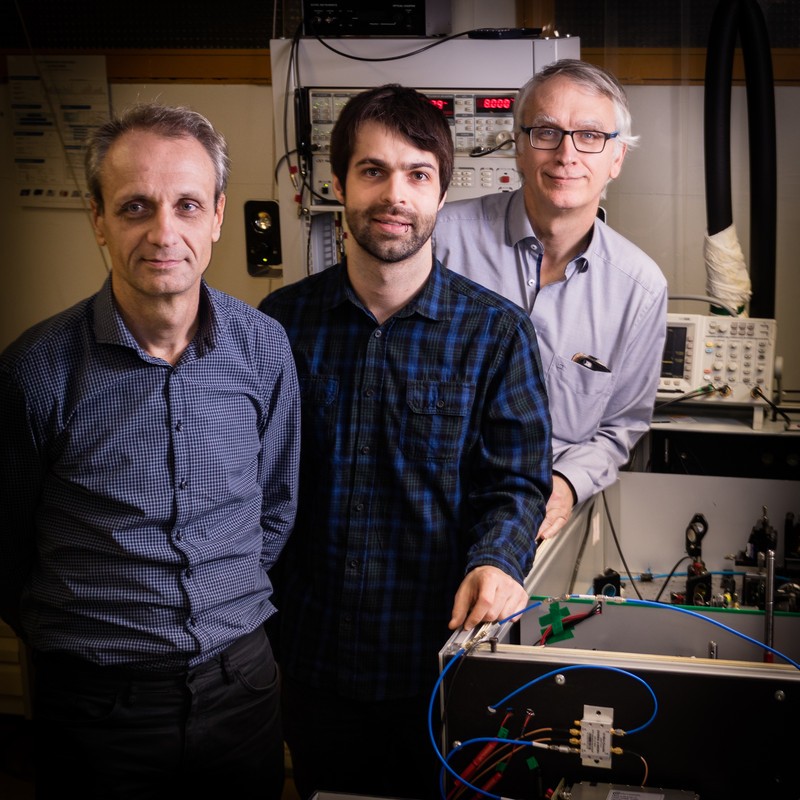
Juraj Darmo, Dominic Bachmann, Karl Unterrainer
A group of scientists from TU Wien and ETH Zurich have succeeded in their attempts to generate ultrashort terahertz light pulses. With lengths of just a few picoseconds, these pulses are ideally suited to spectroscopic applications and enable extremely precise frequency measurements to be taken. Illustration of a broadband terahertz amplifier based on a quantum cascade laser. It allows for an amplifier range of more than 1 THz and the generation of ultrashort light pulses with record pulse widths of 3 ps. The unique properties of terahertz radiation mean it is of interest for a wide range of potential applications, including non-invasive medical imaging and the detection of hazardous substances. Terahertz waves can penetrate many materials that are opaque to visible light and, unlike X-radiation, do not pose a risk of damage to biological tissue. In addition to this, many substances have a molecular fingerprint in the terahertz range, allowing them to be detected using spectroscopic methods.
TO READ THIS ARTICLE, CREATE YOUR ACCOUNT
And extend your reading, free of charge and with no commitment.