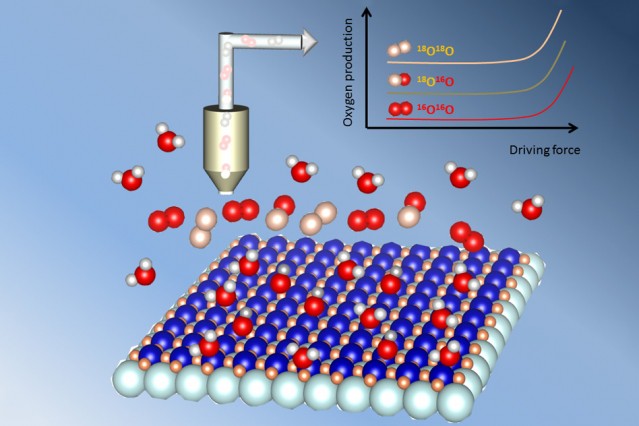
New research shows that when metal oxide (flat array of atoms at bottom) is used as a catalyst for splitting water molecules, some of the oxygen produced comes out of the metal oxide itself, not just from the surrounding water. This was proved by first using water with a heavier isotope of oxygen (oxygen 18, shown in white), and later switching to ordinary water (made with oxygen 16, shown in red). The detection of the heavier oxygen 18 in the resulting gas proves that this came out of the catalyst.
Chemical reactions that release oxygen in the presence of a catalyst, known as oxygen-evolution reactions, are a crucial part of chemical energy storage processes, including water splitting, electrochemical carbon dioxide reduction, and ammonia production. The kinetics of this type of reaction are generally slow, but compounds called metal oxides can have catalytic activities that vary over several orders of magnitude, with some exhibiting the highest such rates reported to date. The physical origins of these observed catalytic activities is not well-understood. Now, a team at MIT has shown that in some of these catalysts oxygen doesn't come only from the water molecules surrounding the catalyst material; some of it comes from within the crystal lattice of the catalyst material itself. The new findings are being reported this week , in a paper by recent MIT graduate Binghong Han PhD '16, postdoc Alexis Grimaud, Yang Shao-Horn, the W.M. Keck Professor of Energy, and six others. The research was aimed at studying how water molecules are split to generate oxygen molecules and what factors limit the reaction rate, Grimaud says. Increasing those reaction rates could lead to more efficient energy storage and retrieval, for example, so determining just where the bottlenecks may be in the reaction is an important step toward such improvements.
TO READ THIS ARTICLE, CREATE YOUR ACCOUNT
And extend your reading, free of charge and with no commitment.