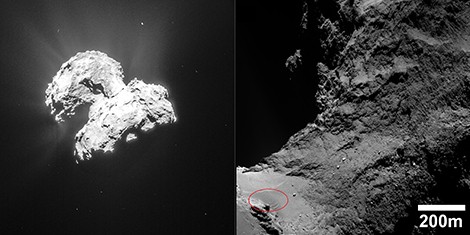
 © ESA/Rosetta/MPS for OSIRIS Team MPS/UPD/LAM/IAA/SSO/INTA/UPM/DASP/IDA). Left, an image of comet Chury showing outgassing of water vapor, which entrains dust (© ESA/Rosetta/NAVCAM). Right, the neck region, between the comet’s two lobes. Various types of relief can be seen, including the dunes, at bottom left (circled in red), in the sandy region.
Surprising images from the Rosetta spacecraft show the presence of dune-like patterns on the surface of comet Chury. Researchers at the Laboratoire de Physique et Mécanique des Milieux Hétérogènes (CNRS/ESPCI Paris/UPMC/Université Paris Diderot) studied the available images and modeled the outgassing of vapor to try to explain the phenomenon. They show that the strong pressure difference between the sunlit side of the comet and that in shadow generates winds able to transport grains and form dunes. Their work is published on 21 February 2017 in the journal PNAS . The formation of sedimentary dunes requires the presence of grains and of winds that are strong enough to transport them along the ground. However, comets do not have a dense, permanent atmosphere as on Earth. Nonetheless, the OSIRIS camera on board the Rosetta spacecraft showed the presence of dune-like forms approximately ten meters apart on 67P/Churyumov-Gerasimenko.
TO READ THIS ARTICLE, CREATE YOUR ACCOUNT
And extend your reading, free of charge and with no commitment.
Your Benefits
- Access to all content
- Receive newsmails for news and jobs
- Post ads