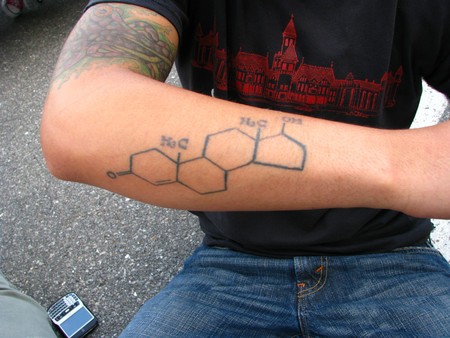
A study shows that testosterone, whose molecular structure is depicted in the above tattoo, hampers decision making and increases impulsive behavior in men.
Hotheaded, impulsive men who shoot first and ask questions later are a staple of Westerns and 1970s cop films, but new research shows there might be truth to the trope. A study conducted by researchers from Caltech, the Wharton School, Western University, and ZRT Laboratory tested the hypothesis that higher levels of testosterone increase the tendency in men to rely on their intuitive judgments and reduce cognitive reflection'a decision-making process by which a person stops to consider whether their gut reaction to something makes sense. The researchers found that men given doses of testosterone performed more poorly on a test designed to measure cognitive reflection than a group given a placebo. The research will appear in an upcoming issue of the journal Psychological Science . "What we found was the testosterone group was quicker to make snap judgments on brain teasers where your initial guess is usually wrong," says Caltech's Colin Camerer, the Robert Kirby Professor of Behavioral Economics and T&C Chen Center for Social and Decision Neuroscience Leadership Chair. "The testosterone is either inhibiting the process of mentally checking your work or increasing the intuitive feeling that 'I'm definitely right.'" The study, which is one of the largest of its type ever conducted, included 243 males who were randomly selected to receive a dose of testosterone gel or placebo gel before taking a cognitive reflection test. A math task was also given to control for participant engagement, motivation level, and basic math skills. The questions included on the cognitive reflection test are exemplified by the following: A bat and a ball cost $1.10 in total. The bat costs $1 more than the ball. How much does the ball cost?
TO READ THIS ARTICLE, CREATE YOUR ACCOUNT
And extend your reading, free of charge and with no commitment.