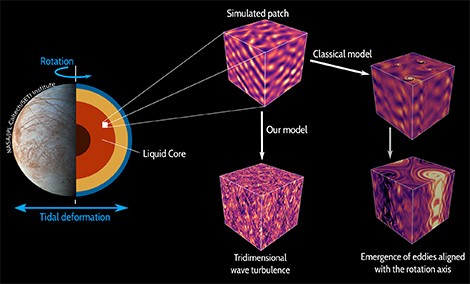
 © Thomas Le Reun / Institut de Recherche sur les Phénomènes Hors Equilibre (IRPHE, CNRS/Aix Marseille Université/Centrale Marseille). Left: simulation of a cubic parcel located in the liquid core of a planet disturbed by tidal effects. By focusing their electronic analysis on this reduced domain, researchers have accessed regimes similar to planetary regimes. The flow takes the shape of superimposed waves that interact non-linearly until forming three-dimensional wave inertia turbulence (see vertical vorticity field in the center), by contrast with models where flow becomes larger-scale turbulence structures aligned with the axis of rotation .
Veritable shields against high-energy particles, planets' magnetic fields are produced by iron moving in their liquid core. Yet the dominant model for explaining this system does not fit the smallest celestial bodies. Researchers at the Institut de Recherche sur les Phénomènes Hors Equilibre (IRPHE, CNRS/Aix Marseille Université/Centrale Marseille) and the University of Leeds have proposed a new model suggesting that turbulence in the liquid cores is due to tides produced by gravitational interactions between celestial bodies. The model infers that instead of being due to large, turbulent molten iron vortices far from the surface, movements in the core are due to the superposition of many wave-type motions. This work was published in Physical Review Letters on July 21, 2017. Scientists agree that magnetic fields form and remain due to iron flowing in the liquid core. Discussions become more complicated when they attempt to determine what allows these colossal masses to move.
TO READ THIS ARTICLE, CREATE YOUR ACCOUNT
And extend your reading, free of charge and with no commitment.
Your Benefits
- Access to all content
- Receive newsmails for news and jobs
- Post ads