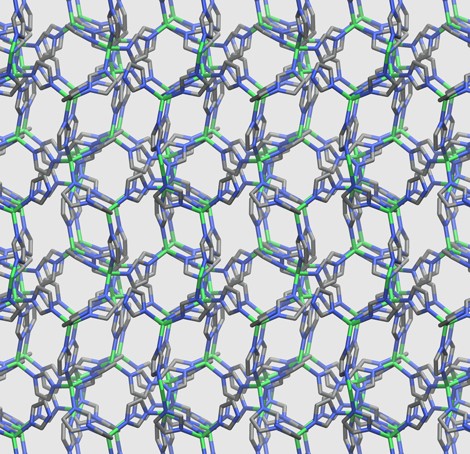
 © F.-X. Coudert / CNRS Crystalline structure of the ZIF-4 material at room temperature
Known for their exceptional porosity that enables the trapping or transport of molecules, metal-organic frameworks (MOFs) take the form of a powder, which makes them difficult to format. For the first time, an international team led by scientists from the Institut de recherche de Chimie Paris (CNRS/Chimie ParisTech )
1, and notably involving Air Liquide, has evidenced the surprising ability of a type of MOF to retain its porous properties in the liquid and then glass state. Published on October 9, 2017 website, these findings open the way towards new industrial applications. Metal-organic frameworks (MOFs) constitute a particularly promising class of materials. Their exceptional porosity makes it possible to store and separate large quantities of gas, or to act as a catalyst for chemical reactions. However, their crystalline structure implies that they are produced in powder form, which is difficult to store and use for industrial applications. For the first time, a team of scientists from the CNRS, Chimie ParisTech, Cambridge University, Air Liquide and the ISIS (UK) and Argonne (US) synchrotrons has shown that the properties of a zeolitic MOF were unexpectedly conserved in the liquid phase (which does not generally favor porosity).
TO READ THIS ARTICLE, CREATE YOUR ACCOUNT
And extend your reading, free of charge and with no commitment.
Your Benefits
- Access to all content
- Receive newsmails for news and jobs
- Post ads