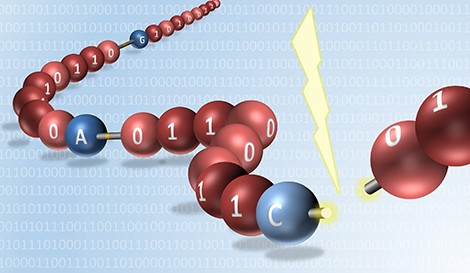
 © Jean-François Lutz, Institut Charles Sadron (CNRS). By inserting fragile bonds between each molecular "byte,” digital polymers may be easily read through mass spectrometry.
For the first time ever, using mass spectrometry, researchers have successfully read several bytes
1 of data recorded on a molecular scale using synthetic polymers. Their work, conducted under the aegis of the Institut Charles Sadron (CNRS) in Strasbourg and the Institute of Radical Chemistry (CNRS / Aix-Marseille University), sets a new benchmark for the amount of data—stored as a sequence of molecular units (monomers)—that may be read using this routine method. It also sets the stage for data storage on a scale 100 times smaller than that of current hard drives. The scientists' findings are published on October 17, 2017. Will hard drives one day use polymers for data storage? For several years now, researchers have faced the challenge of trying to record information with these long molecules. Polymers have great potential since, to record a bit,
1 their component monomers require 100 times less space than current hard drives. Their use could therefore dramatically reduce the size of computer storage media.
TO READ THIS ARTICLE, CREATE YOUR ACCOUNT
And extend your reading, free of charge and with no commitment.
Your Benefits
- Access to all content
- Receive newsmails for news and jobs
- Post ads