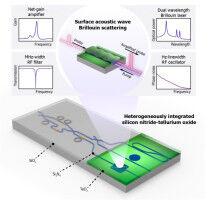
This cloaking grenade, used for hiding troop operations from view on the battlefield, is an example of nanoparticles that reflect a particular color of light based on their exact size and composition. New work by MIT researchers provides a way to predict the light-scattering properties of layered nanoparticles - or to design particles to match a desired type of light-scattering behavior.
A new technique developed by MIT physicists could someday provide a way to custom-design multilayered nanoparticles with desired properties, potentially for use in displays, cloaking systems, or biomedical devices. It may also help physicists tackle a variety of thorny research problems, in ways that could in some cases be orders of magnitude faster than existing methods. The innovation uses computational neural networks, a form of artificial intelligence, to "learn" how a nanoparticle's structure affects its behavior, in this case the way it scatters different colors of light, based on thousands of training examples. Then, having learned the relationship, the program can essentially be run backward to design a particle with a desired set of light-scattering properties - a process called inverse design. The findings are being reported in the journal Science Advances , in a paper by MIT senior John Peurifoy, research affiliate Yichen Shen, graduate student Li Jing, professor of physics Marin Solja'i', and five others. While the approach could ultimately lead to practical applications, Solja'i? says, the work is primarily of scientific interest as a way of predicting the physical properties of a variety of nanoengineered materials without requiring the computationally intensive simulation processes that are typically used to tackle such problems. Solja'i? says that the goal was to look at neural networks, a field that has seen a lot of progress and generated excitement in recent years, to see "whether we can use some of those techniques in order to help us in our physics research.
TO READ THIS ARTICLE, CREATE YOUR ACCOUNT
And extend your reading, free of charge and with no commitment.