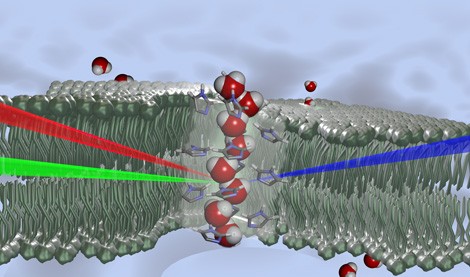
 © CNRS Schematic representation of water molecules with a wire-like structure oriented in a single direction in the core of a channel, shown as transparent. Formed from histamine derivatives, this chiral channel forms spontaneously within the phospholipid bilayer (in white) stabilized in aqueous medium (in blue). It generates a driving force for water transport.
Access to clean drinking water is considered to be one of the main challenges of the 21st Century, and scientists have just opened a path to new filtration processes. Inspired by cellular proteins, they have developed membranes with asymmetric artificial channels in the interior, from which they were able to observe “chiral” water
1. Chirality is a property that favors the flow of materials that are indispensable to filtration. This work, conducted by CNRS researchers from the Institut Européen des Membranes (CNRS/ENSCM/Université de Montpellier) and the Laboratoire CNRS de Biochimie Théorique, in collaboration with US scientists, was published in Science Advances on March 23, 2018. From a desire to develop breakthrough technologies for water filtration and purification, researchers have developed membranes with artificial channels inspired by the proteins that form the pores in biological membranes: aquaporins. Using an innovative spectroscopic technique, they have been able to observe that, in the very restricted space in these channels, water molecules organize in a very regular manner, in an oriented molecular wire structure : the water has become “chiral. Identifying the chiral water in the artificial channels in these lipid membranes, under physiological conditions similar to natural pores, was a tour de force.
TO READ THIS ARTICLE, CREATE YOUR ACCOUNT
And extend your reading, free of charge and with no commitment.
Your Benefits
- Access to all content
- Receive newsmails for news and jobs
- Post ads