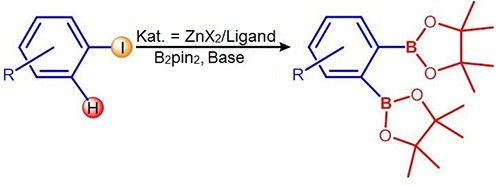
Mit Zink als Katalysator lassen sich ringförmige Moleküle simultan mit zwei Boronatgruppen bestücken. ( Todd Marder)
08/20/2015 - Abandoning expensive and toxic materials in chemical synthesis: This is the goal pursued by scientists at the University of Würzburg. In the magazine "Angewandte Chemie", they describe a new way to achieve this goal, a surprise included. Arylboronates are important base materials for the industrial fabrication of countless products, including pharmaceutical drugs, chemicals for agriculture or liquid crystals for displays. The synthesis of arylboronates to date has required metalliferous catalysts such as palladium, iridium or nickel. These materials have a number of drawbacks: The metals are either expensive, toxic or both. Nickel, for example, can trigger allergies. When used in pharmaceutical drug production, the nickel has to be removed again after the reaction in a complex process. Progress with zinc catalysts The Würzburg chemists Shubhankar Kumar Bose and Todd Marder now present an entirely new catalytic process that enables arylboronates to be produced at lower costs and with less environmental impact. Their success is based on the use of zinc catalysts. "Zinc is cheap, non-toxic and abundant on our planet," Marder names some of the metal's benefits. As the team reports in "Angewandte Chemie", a baffling effect occurred during their research work. The scientists haven't been able to fully account for the effect yet, but it should cause a stir among experts, because it might deliver the key to facilitating the synthesis of many important arylboronates in the future. Simultaneous bonding of boronate groups What caused the astonishment?
TO READ THIS ARTICLE, CREATE YOUR ACCOUNT
And extend your reading, free of charge and with no commitment.