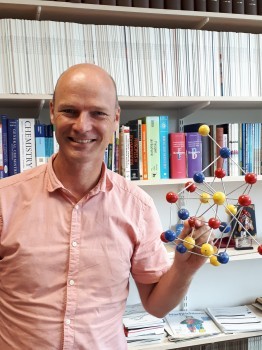
 Bart Jan Ravoo
'Key-and-lock recognition' through co-assembling points of contact on a nanoscale / Potential for diagnostics, imaging and active ingredients in medicines A new method of selectively binding proteins to nanoparticles has been described by a team of German and Chinese researchers headed by Prof. Bart Jan Ravoo, a chemist at the "Center for Soft Nanoscience" at the University of Münster. The nanoparticles automatically recognize specific peptides, i.e. small proteins, and enter into highly selective binding with them. Among the model peptides which the researchers examined were amyloids. Deposits of amyloids, for example, play a major role in Alzheimer's disease, so the researchers are hoping that the mechanism they have discovered might provide a new approach to treating diseases in which such deposits occur. The study has been published in the latest issue of the "Nature Chemistry" journal. Producing exact contact surfaces The interaction between protein molecules or between them and other biomolecules plays a major role in very many physiological processes. In this context, molecular recognition entails the binding of proteins through multiple nanoscale points of contact on the surface of the protein.
TO READ THIS ARTICLE, CREATE YOUR ACCOUNT
And extend your reading, free of charge and with no commitment.
Your Benefits
- Access to all content
- Receive newsmails for news and jobs
- Post ads