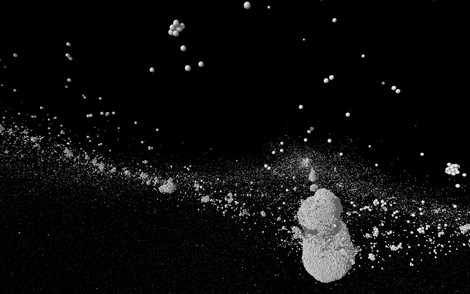
 © © ESA/Rosetta/Navcam – CC BY-SA IGO 3.0 Image of the final stage of a simulation, carried out by the authors, of a catastrophic collision between comets, showing one of the objects formed by re-accretion of debris from the collision, with a shape identical to that of Chury.
Comets made up of two lobes, such as Chury, visited by the Rosetta spacecraft, are produced when the debris resulting from a destructive collision between two comets clumps together again. Such collisions could also explain some of the enigmatic structures observed on Chury. This discovery, made by an international team coordinated by Patrick Michel, CNRS researcher at the laboratoire Lagrange (CNRS/Observatoire de la Côte d'Azur/Université de Nice-Sophia Antipolis
1), was published on 5 March 2018 in Nature Astronomy . Ever since Giotto visited Halley's comet in 1986, a few spacecraft have flown close to several cometary nuclei. It turns out that most of them appeared to be elongated or even made up of two lobes, such as the well-known Chury, which was observed at very short range by the Rosetta spacecraft in 2014 and 2015. Astronomers believe that this astonishing shape can be explained by the merger of two formerly separate comets. The two comets would have to exhibit very low density and be rich in volatile elements, and therefore be moving very slowly, to enable them to come together and collide gently without exploding. For a number of reasons it is usually assumed that this type of gentle encounter only occurred in the initial stages of the Solar System, more than four billion years ago. However, there remains a mystery: how could such fragile bodies of the size of Chury, formed so long ago, have survived until now, given that they are constantly subjected to collisions in the regions where they orbit?
TO READ THIS ARTICLE, CREATE YOUR ACCOUNT
And extend your reading, free of charge and with no commitment.
Your Benefits
- Access to all content
- Receive newsmails for news and jobs
- Post ads