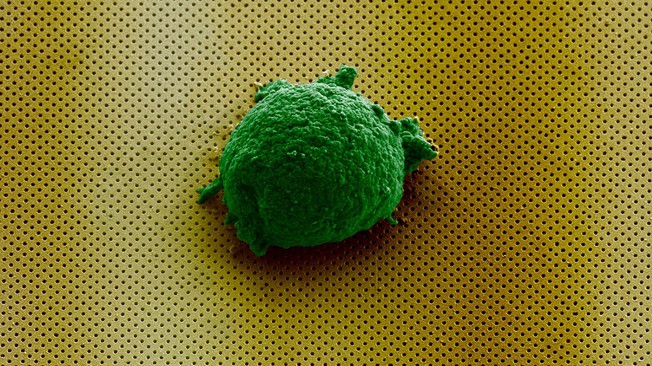
 Microscopic image of a single cell artificially colored, laying on billions of nanoholes© Cover image of the forthcoming edition of Small / 2018 EPFL
EPFL researchers have developed an innovative label-free method for studying the behavior of single cells continuously and in real time. By placing a cell in a small chamber containing nanosensors and observing it over many hours, it is possible to identify the cell's unique personality and understand how it communicates. This powerful new technology could be used to select the most aggressive cells to combat an enemy. Potential applications include treatments for cancer and autoimmune diseases. Like humans, cells of the same species each have a distinct "personality." When confronted with an external stimulus like a virus, they each secrete a different quantity of molecules and communicate with each other to a varying degree. Studies have already shown that two cells of the same type may not behave identically when subjected to the same treatment. In their quest to learn more, researchers from EPFL, working in collaboration with RMIT University in Australia and the University of Lausanne, have come up with an optofluidic device that has a tiny chamber inside.
TO READ THIS ARTICLE, CREATE YOUR ACCOUNT
And extend your reading, free of charge and with no commitment.
Your Benefits
- Access to all content
- Receive newsmails for news and jobs
- Post ads



