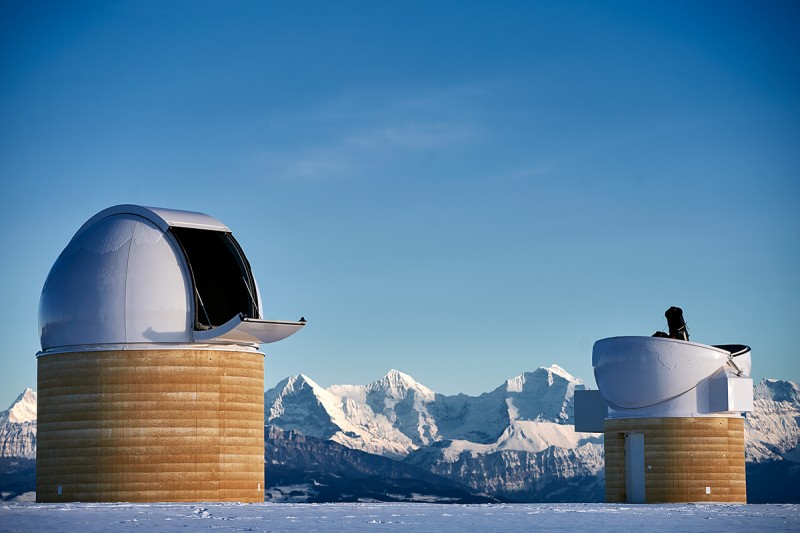
 The two new domes of the Zimmerwald Observatory with 5,3m (left) and 4,5m (right) diameter.
The Astronomical Institute of the University of Bern (AIUB) has extended its observatory in Zimmerwald with two additional domed structures, and has renovated a dome. As a result, there are now six fully automated telescopes available for observation and specifically for detecting and cataloguing space debris. The research station is thus gaining even greater international significance under the name "Swiss Optical Ground Station and Geodynamics Observatory". On the afternoon of 10 February 2009, the operational communications satellite Iridium 33 collided with the obsolete Cosmos 2251 communications satellite over Siberia at an altitude of roughly 800 kilometres. The collision happened at a speed of 11 kilometres per second and produced a cloud of more than 2,000 pieces of debris larger than ten centimetres. This debris spread out over an extensive area within a few months, and has been threatening to collide with other operational satellites since then. "This incident was the ultimate wake-up call for all satellite operators but also for politics," says Thomas Schildknecht, Director of the Zimmerwald Observatory. The problem of space debris, obsolete artificial objects in space, took on a new dimension. Experts and space agencies have already been dealing with this problem for nearly 50 years. Researchers at the University of Bern supply scientific and empirical bases for models and measures to stabilise the number of objects, to make the safe and sustainable use of space possible in the future too. Findings thanks to highly complex measurements
TO READ THIS ARTICLE, CREATE YOUR ACCOUNT
And extend your reading, free of charge and with no commitment.
Your Benefits
- Access to all content
- Receive newsmails for news and jobs
- Post ads