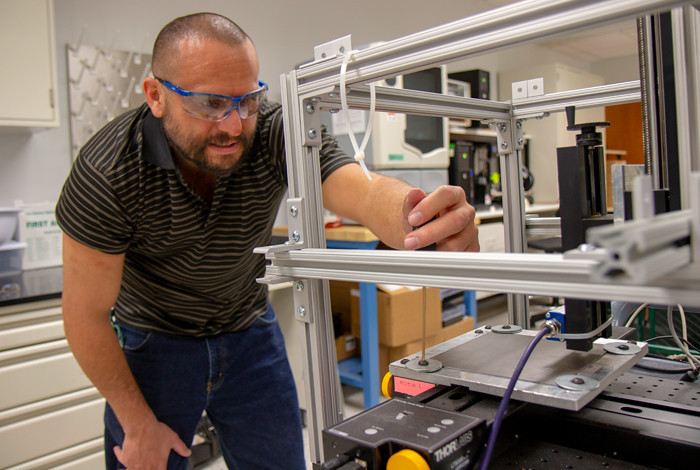
David Mascarenas, a research and development engineer at Los Alamos National Laboratory, used Barkhausen noise to find unique-looking ’fingerprints’ in steel that could help to verify weapons treaties and reduce the use of counterfeit bolts in the construction industry.
Treaty compliance aided by spotting illicit artillery exchange and duplication LOS ALAMOS, N.M. Nov. Researchers using magnetic signals have found unique "fingerprints” on steel, which could help to verify weapons treaties and reduce the use of counterfeit bolts in the construction industry. "Magnetic signals provide a wide range of possible national security applications,” said David Mascareñas, a research and development engineer at Los Alamos National Laboratory and lead author of the study published recently in the journal Smart Materials and Structures . "It's a promising phenomenon that we hope to leverage to uniquely identify different pieces of artillery. In the research, funded by the U.S Department of State, researchers applied Barkhausen noise, a magnetic phenomenon, to two types of steel - conventional steel and an abrasive-resistant type of steel used in mining equipment. A sensor measured electromagnetic signals by repeatedly scanning the different kinds of steel over a period of time. Researchers compared the signals from those two sets of scanned images and found signatures that were intrinsic to each type of steel.
TO READ THIS ARTICLE, CREATE YOUR ACCOUNT
And extend your reading, free of charge and with no commitment.