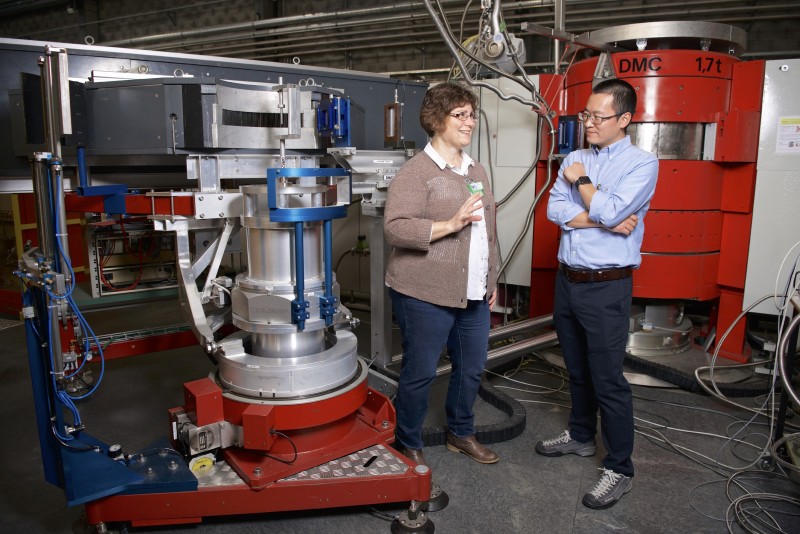
Marisa Medarde and Tian Shang at the neutron diffractometer DMC. With this device Shang found out where the atoms are located in the crystal lattice and how far apart they are from each other. (Photo: Paul Scherrer Institute/Markus Fischer)
A new material for energy-efficient data storage reaches computer operating temperature Multiferroics are considered miraculous materials for future data storage - as long as their special properties can be preserved at computer operating temperatures. This task has now been accomplished by researchers at the Paul Scherrer Institute PSI, with colleagues from Institut Laue-Langevin ILL in Grenoble. With this, they have taken these materials one step closer to practical applications. The use of multiferroics holds promise for more energy-efficient computers because an electric field would suffice for magnetic data storage. To produce this, much less power and cooling are required than with conventional magnetic storage. Multiferroics combine magnetic and electrical properties to form a material that is extremely rare. Most such materials only exhibit these two properties at temperatures well below the freezing point.
TO READ THIS ARTICLE, CREATE YOUR ACCOUNT
And extend your reading, free of charge and with no commitment.