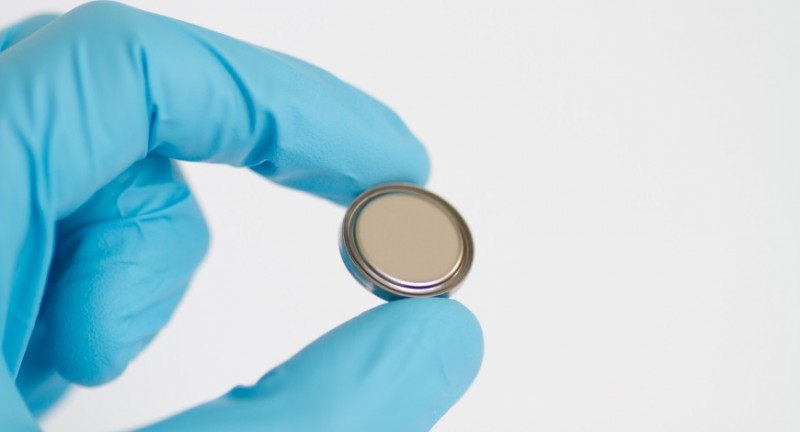
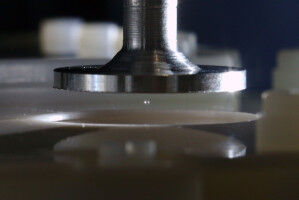
The researchers produced aluminium button cells in the laboratory. The battery case is made of stainless steel coated with titanium nitride on the inside to make it corrosion resistant. (Picture: Empa / ETH Zurich)
The energy transition depends on technologies that allow the inexpensive temporary storage of electricity from renewable sources. A promising new candidate is aluminium batteries, which are made from cheap and abundant raw materials. Scientists from Maksym Kovalenko's research group, which is based at both ETH Zurich and in Empa's Laboratory for Thin Films and Photovoltaics , are researching and developing batteries made from abundant raw materials. The researchers have now identified two new materials that could bring about key advances in the development of aluminium batteries. The first is a corrosion-resistant material for the conductive parts of the battery; the second is a novel material for the battery's positive pole that can be adapted to a wide range of technical requirements. As the electrolyte fluid in aluminium batteries is extremely aggressive and corrodes stainless steel, and even gold and platinum, scientists are searching for corrosion-resistant materials for the conductive parts of these batteries. Kovalenko and his colleagues at the Laboratory for Thin Films and Photovoltaics at Empa have found what they are looking for in titanium nitride, a ceramic material that exhibits sufficiently high conductivity.
TO READ THIS ARTICLE, CREATE YOUR ACCOUNT
And extend your reading, free of charge and with no commitment.