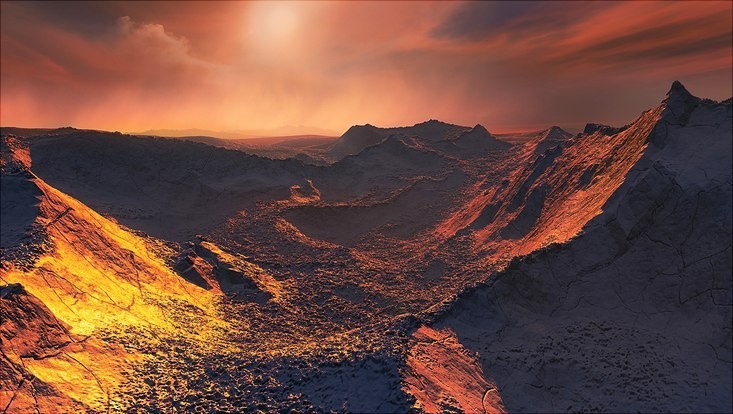
Photo: ESO/Martin Kornmesser Artistic illustration of a sunset on Barnard’s star b
Astronomers from the Observatory of the University of Hamburg were involved in the discovery of a new planet. As part of an international research team led by the Institut de Ciències de l'Espai (ICE, CSIC), they have found a planet in orbit of Barnard's star. Barnard's star is a so-called red dwarf and after the Alpha-Centauri triple stellar system the second closest star to the Sun. As scientists reported in the current issue of Nature, they used astronomical observational data from about 20 years ago and combined it with new measurement data taken with the CARMENES planet-hunter spectrograph at Calar Alto/Spain among others. The astronomers found significant evidence for a super-Earth with the size of 3. Earth masses, orbiting the red dwarf every 233 days. The new planet is at the so-called snowline of the star and is likely to be a frozen world.
TO READ THIS ARTICLE, CREATE YOUR ACCOUNT
And extend your reading, free of charge and with no commitment.