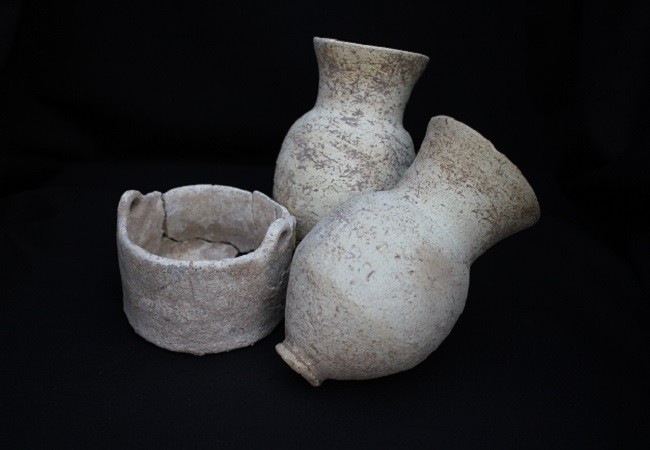
Drinking Cup And Faience Bucket excavated from Khani Masi
University of Glasgow research identifies barley beer in Bronze Age Mesopotamian drinking vessels. People living some 3500 years ago in Mesopotamia, which now is modern-day Iraq, enjoyed a pint as much as we do today. A paper published in The Journal of Archaeological Science shows that Mesopotamia's Late Bronze Age inhabitants enjoyed drinking barley beer not unlike today's popular craft brews from a variety of drinking vessels. Chemical compounds indicative of a barley-based fermented drink were discovered in numerous pottery vessels at the Bronze Age Site of Khani Masi located in the Upper Diyala River valley of north-eastern Iraq. An international team led by Dr Claudia Glatz (University of Glasgow) and Professor Jesse Casana (Dartmouth College, USA) has been carrying out large-scale excavations at Khani Masi since 2016 as part of the Sirwan Regional Project. Beer was both a staple of the Mesopotamian diet and an important component of rituals and feasting - and has been studied mainly through cuneiform sources and iconography. Traditionally, scholars have assumed that beer in Mesopotamia was consumed communally from large jars using long, bendy straws. However, the paper entitled Revealing invisible brews: A new approach to the chemical identification of ancient beer says: "Our analytical results also allow us, for the first time and with confidence, to ascribe a diverse range of drinking equipment to the consumption of beers and in so doing track a significant transformation in Mesopotamian drinking practices." The new research shows that by 1400 BC beer drinking had become an individual experience using drinking cups and goblets ranging in size from a modern-day equivalent of a small glass of wine up to just over a pint glass of beer.
TO READ THIS ARTICLE, CREATE YOUR ACCOUNT
And extend your reading, free of charge and with no commitment.