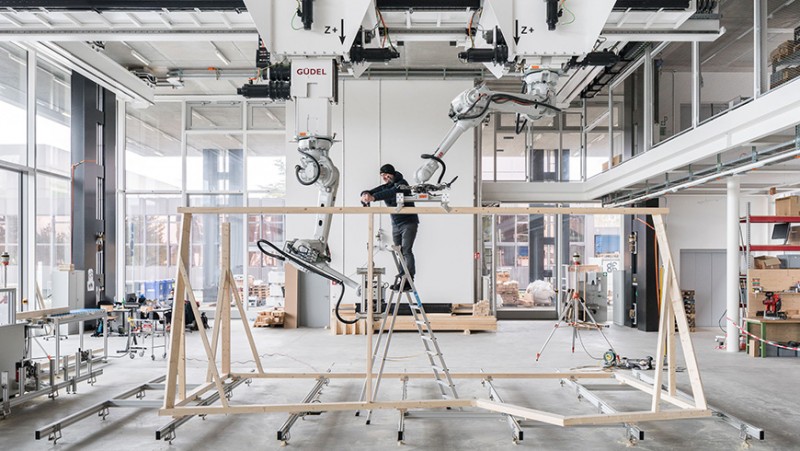
 An project member manually bolts the timber beams together that have been jointly preplaced by the two robots.
Researchers from ETH Zurich are using a new method for digital timber construction in a real-world project for the first time. The load-bearing timber modules, which are prefabricated by robots, will be assembled in the "DFAB HOUSE" unit at Empa and Eawag's NEST research and innovation building, thus combining architecture with robotics and craftsmanship. Digitalization has found its way into timber construction, with entire elements already being fabricated by computer-aided systems. The raw material is cut to size by the machines, but in most cases it still has to be manually assembled to create a plane frame. In the past, this fabrication process came with many geometric restrictions. Under the auspices of the National Centre of Competence in Research (NCCR) Digital Fabrication, researchers from ETH Zurich's Chair of Architecture and Digital Fabrication have developed a new, digital timber construction method that expands the range of possibilities for traditional timber frame construction by enabling the efficient construction and assembly of geometrically complex timber modules. "Spatial Timber Assemblies" evolved from a close collaboration with Erne AG Holzbau and will be used for the first time in the " DFAB HOUSE " unit at the NEST research and innovation building of Empa and Eawag in Dübendorf.
TO READ THIS ARTICLE, CREATE YOUR ACCOUNT
And extend your reading, free of charge and with no commitment.
Your Benefits
- Access to all content
- Receive newsmails for news and jobs
- Post ads