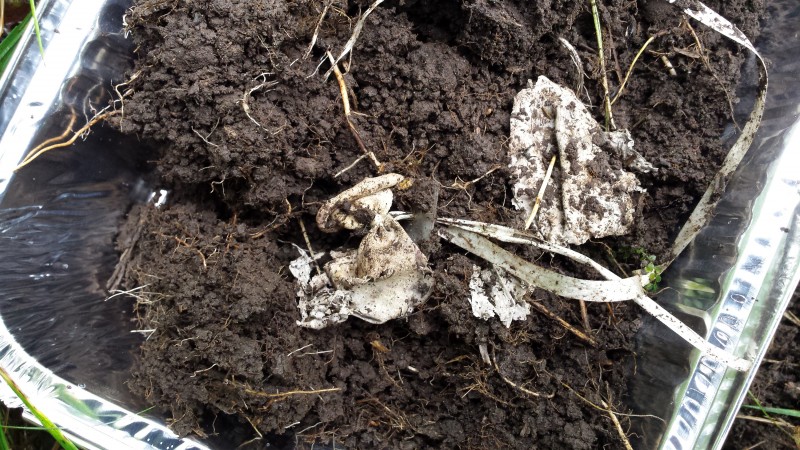
 Also small balloons eventually turn into microplastics: remains of a balloon in a floodplain soil in the Vallée de Joux in the Canton of Vaud.
It is one of the first research projects into the existence of microplastics in the soil: Scientists at the University of Bern investigated floodplain soils in Swiss nature reserves for microplastics - and made a find. They estimate, that there are around 53 tonnes of microplastics lying in the top five centimetres of the floodplain. Even many of the soils in remote, protected mountainous areas, are contaminated with microplastics. The images of oceans and inland lakes polluted with microplastics are not new. In contrast, it is almost unknown that even soils are contaminated with microplastics. The problem: Until now, there were no methods to measure and quantify the smallest plastic particles in a soil. The researchers of the Geographical Institute of the University of Bern therefore developed a new method, and for the first time, 29 floodplain soils were investigated all over Switzerland, from Geneva to Grisons.
TO READ THIS ARTICLE, CREATE YOUR ACCOUNT
And extend your reading, free of charge and with no commitment.
Your Benefits
- Access to all content
- Receive newsmails for news and jobs
- Post ads


