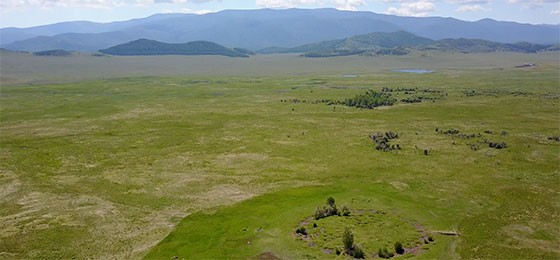
Aerial view of the burial mound Tunnug 1 (Arzhan 0). A distinct circle can be seen on one plane
Deep in a swamp in the Russian republic of Tuva, SNSF-funded archaeologist Gino Caspari has discovered an undisturbed Scythian burial mound. All the evidence suggests that this is not only the largest Scythian princely tomb in South Siberia, but also the earliest - and that it may be harbouring some outstandingly well-preserved treasures. Gino Caspari made the most significant find in his career to date not with a shovel, but at a computer. A recipient of Swiss National Science Foundation (SNSF) funding, archaeologist Caspari discovered a circular structure on high-resolution satellite images of the Uyuk River valley (Siberia) on his computer screen. An initial trial dig carried out this summer by the Bern University scientist together with the Russian Academy of Sciences and the Hermitage Museum confirmed his suspicion: the structure is a kurgan, a Scythian princely tomb. Looking back at the beginnings. Working with a Swiss-Russian team, Caspari was able to prove that the burial mound - referred to as Tunnug 1 (or Arzhan 0) - was similar in construction to the kurgan Arzhan 1 located only ten kilometres away to the northeast.
TO READ THIS ARTICLE, CREATE YOUR ACCOUNT
And extend your reading, free of charge and with no commitment.