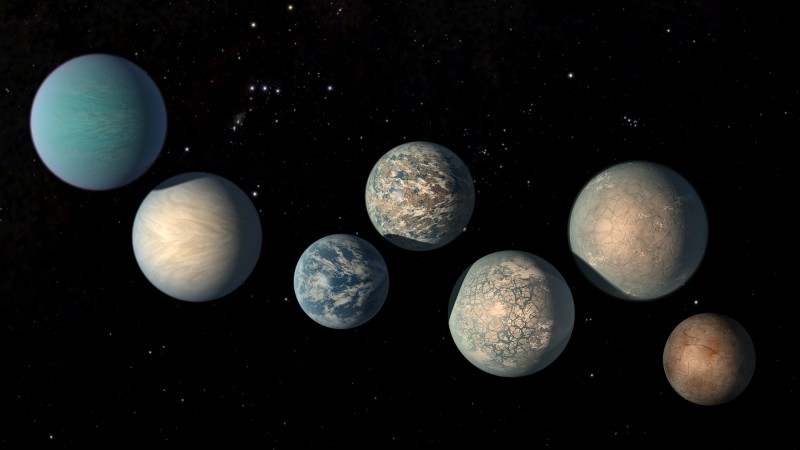
 This illustration shows the seven Earth-size planets of TRAPPIST-1. The image does not show the planets’ orbits to scale, but highlights possibilities for how the surfaces of these intriguing worlds might look.
Researchers at the University of Bern are providing the most precise calculations so far of the masses of the seven planets around the star TRAPPIST-1. From this, new findings are emerging about their density and composition: All TRAPPIST-1 planets consist primarily of rock and contain up to five percent water. This is a decisive step for determining the habitability of these planets. Of the known exoplanets (planets outside our solar system), TRAPPIST-1e is so far the one that is most similar to the Earth in terms of its size, density, and the amount of radiation that it receives from its star. It is the only one of the seven TRAPPIST-1 planets that is somewhat denser than the Earth, and it is not ruled out that liquid water exists on its surface. At least five of the lighter planets have a covering of volatile substances in the form of atmospheres, oceans or layers of ice. Their water content is up to 5 percent, which is a lot when compared to the Earth, where the seas account for only 0.02% of the planet's mass.
TO READ THIS ARTICLE, CREATE YOUR ACCOUNT
And extend your reading, free of charge and with no commitment.
Your Benefits
- Access to all content
- Receive newsmails for news and jobs
- Post ads