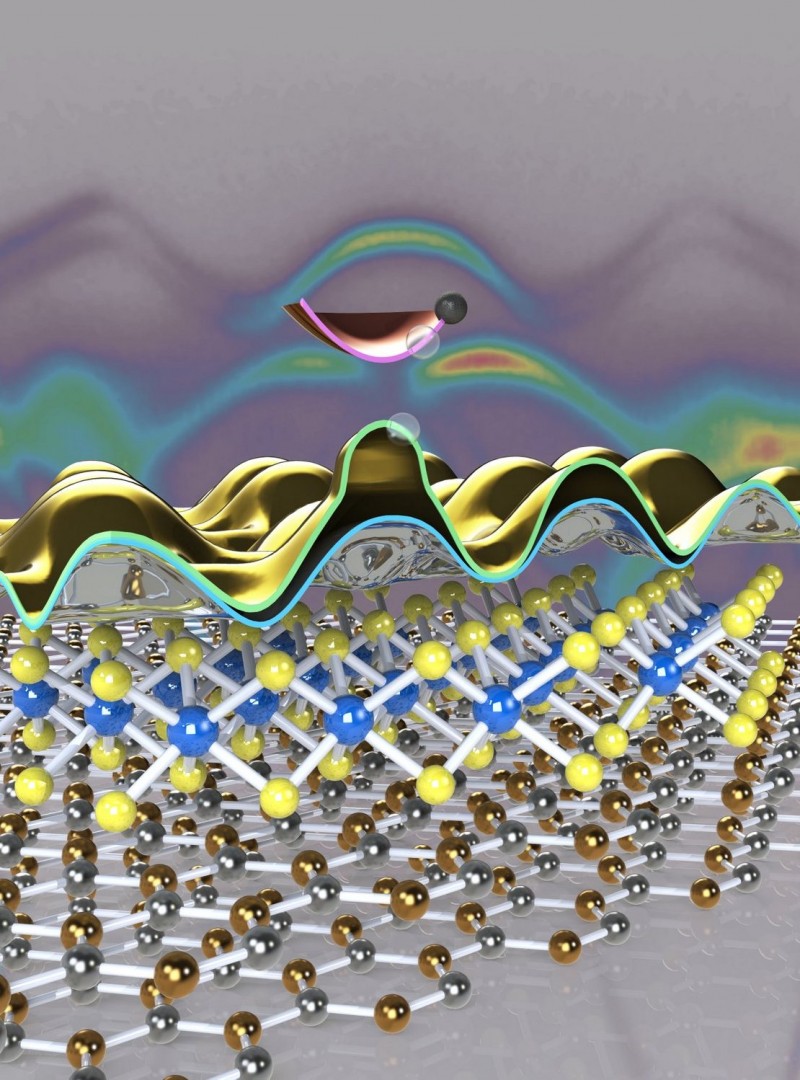
This rendering shows a "ball-and-stick” representation of the atomic structure of a 2-D single crystalline layer of tungsten disulfide (blue and yellow) on top of layers of 2-D boron nitride (silver and gold). On top of these is a representation of the structure of electronic energy levels, or valence bands, within the tungsten disulfide, and the increased splitting between the two valence bands observed using an x-ray technique at the MAESTRO beamline. The experiments suggest the effect could be due to "trions,” made up of two holes and an electron in the bands, depicted as clear and dark spheres. The background is raw data of the electronic structure of the tungsten disulfide, as measured in the experiment. (Credit: Chris Jozwiak/Berkeley Lab)
Scientists at Berkeley Lab use a new platform, called MAESTRO, to see microscale details in monolayer material's electronic structure. To see what is driving the exotic behavior in some atomically thin - or 2-D - materials, and find out what happens when they are stacked like Lego bricks in different combinations with other ultrathin materials, scientists want to observe their properties at the smallest possible scales. Enter MAESTRO , a next-generation platform for X-ray experiments at the Advanced Light Source (ALS) at the Department of Energy's Lawrence Berkeley National Laboratory (Berkeley Lab), that is providing new microscale views of this weird 2-D world. In a study published Jan. 22 , researchers zeroed in on signatures of exotic behavior of electrons in a 2-D material with microscale resolution. The new insights gleaned from these experiments show that the properties of the 2-D semiconductor material they studied, called tungsten disulfide (WS2), may be highly tunable, with possible applications for electronics and other forms of information storage, processing, and transfer. Those applications could include next-gen devices spawned from emerging fields of research like spintronics, excitonics and valleytronics.
TO READ THIS ARTICLE, CREATE YOUR ACCOUNT
And extend your reading, free of charge and with no commitment.