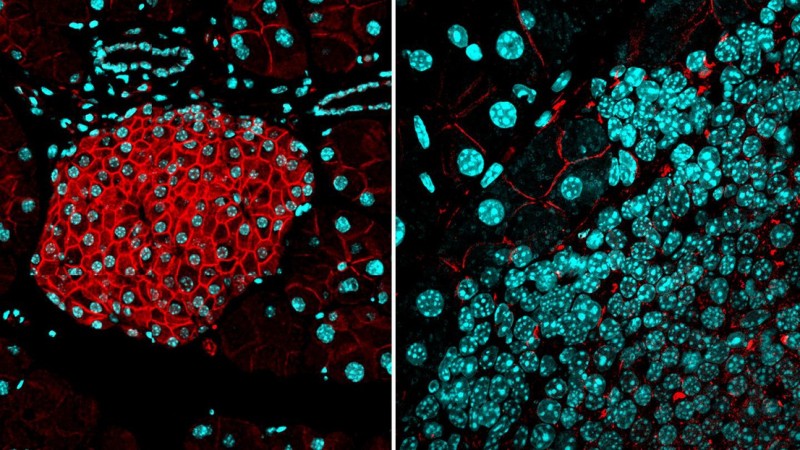
LEFT: a protective barrier of activin B expression (red) is present in normal pancreatic islets. RIGHT: the barrier is absent in islet tumors. Cyan: cell nuclei. Credit: Iacovos Michael/EPFL
Scientists at EPFL have discovered a biological "barrier" that prevents cancer cells from forming new tumors and more importantly, from metastasizing. The study examines pancreatic neuroendocrine tumors and breast cancer. Activins are proteins involved in a number of important biological functions, including the regulation of the menstrual cycle, cell proliferation, differentiation, apoptosis, metabolism, homeostasis, immune response, wound repair, and endocrine function. Activin B is one of the activin proteins. It binds and activates a receptor called ALK7 - a member of the tumor growth factor beta (TGFß) receptors superfamily. When activated, ALK7 triggers a domino effect of molecular and biochemical reactions (a "signaling pathway") that result in various changes across the cell. Now, a team of researchers spearheaded by the lab of Douglas Hanahan at EPFL have found that activin B and ALK7 expressed by cancer cells can form a "barrier" that not only prevents them from forming new tumors, but also from metastasizing.
TO READ THIS ARTICLE, CREATE YOUR ACCOUNT
And extend your reading, free of charge and with no commitment.