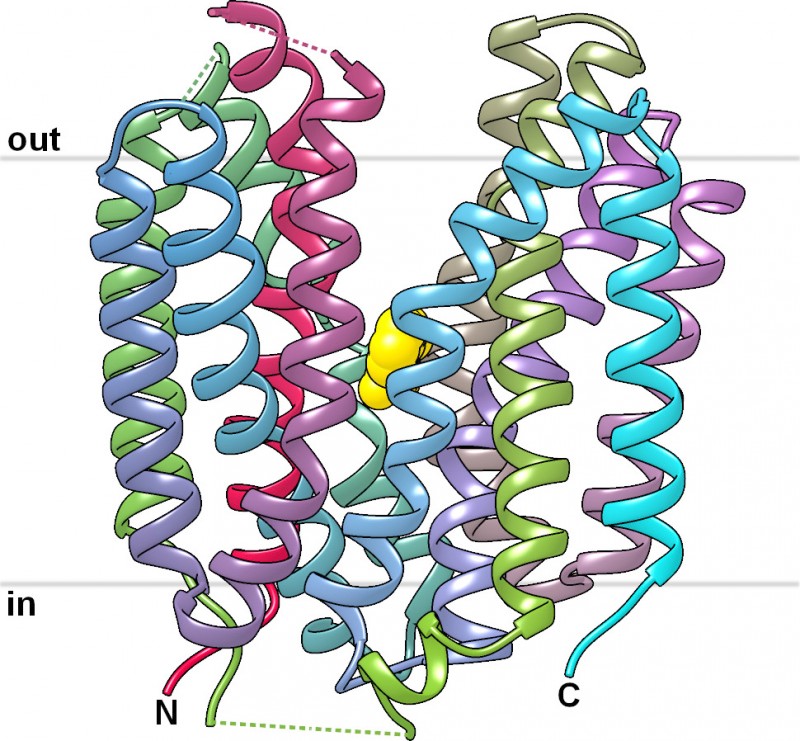
View of the SfMCT transporter structure with «outward open» conformation, where agents could bind. The binding site is coloured in yellow. Copyright: Dimitrios Fotiadis, University of Bern
For the first time, Bernese researchers have been able to solve the structure of a transport protein and thus to describe the functional mechanism that plays a significant role in the survival of cancer cells. This is an important step towards developing effective inhibitors and fight tumor growth. Certain cancer cells depend on exporting the metabolite lactate, which accumulates during the generation on energy. Lactate plays an important role in many biochemical and cellular processes. In healthy cells it is produced if our body is not supplied with enough oxygen during intensive exercise. During this anaerobic energy production, lactate accumulates in cells and acidifies them. In certain cancer cells, metabolic processes are disturbed and large amounts of lactate are produced even if the supply with oxygen is sufficient to cover the energy demand.
TO READ THIS ARTICLE, CREATE YOUR ACCOUNT
And extend your reading, free of charge and with no commitment.