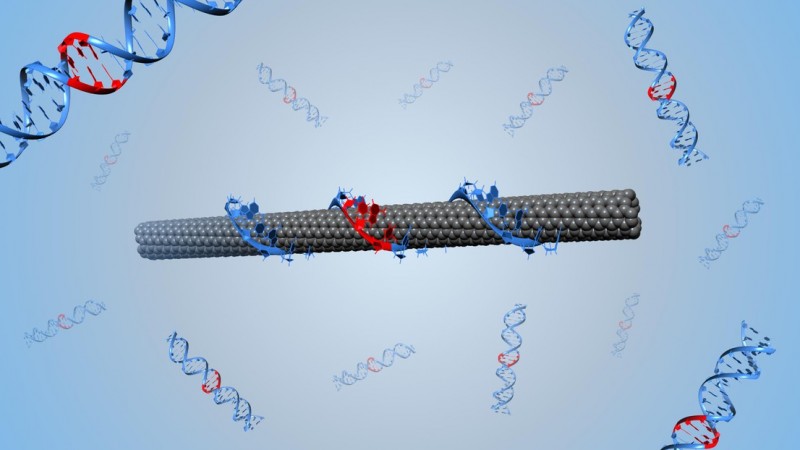
Illustration of a DNA-wrapped single-walled carbon nanotube (credit: Benjamin Lambert, EPFL)
Directed evolution is a powerful technique for engineering proteins. EPFL scientists now show that it can also be used to engineer synthetic nanoparticles as optical biosensors, which are used widely in biology, drug development, and even medical diagnostics such as real-time monitoring of glucose. The 2018 Nobel Prize in Chemistry went to three scientists who developed the method that forever changed protein engineering: directed evolution. Mimicking natural evolution, directed evolution guides the synthesis of proteins with improved or new functions. First, the original protein is mutated to create a collection of mutant protein variants. The protein variants that show improved or more desirable functions are selected. These selected proteins are then once more mutated to create another collection of protein variants for another round of selection.
TO READ THIS ARTICLE, CREATE YOUR ACCOUNT
And extend your reading, free of charge and with no commitment.