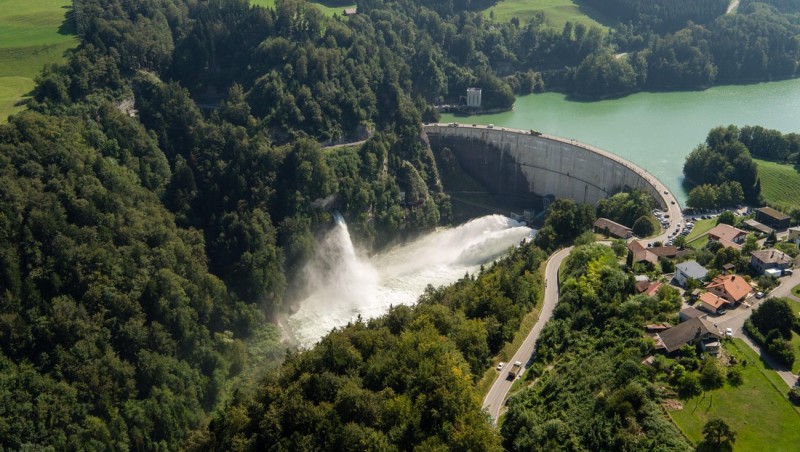
 The Rossens dam during the artificial flood.
Researchers at EPFL conducted a large-scale experiment downstream of Rossens arch dam, employing a laboratory-developed method to successfully preserve wildlife habitats. The absence of natural flood events means that, downstream of dams, rivers always flow at the same rate. The channel bed silts up as time passes, and the lack of sediment replenishment degrades fish and invertebrate habitats and causes species diversity to decline. Until recently, this very fate had befallen the Sarine River downstream of the Rossens arch dam in Fribourg Canton. The vast structure, standing 83 meters high and 320 meters wide, was built in 1948 to hold back the river and create Lake Gruyère. Intervention in 2016 In 2016, ahead of the first artificial flood to be triggered since the dam was built, Groupe E energy supplier and Fribourg Canton invited researchers in to conduct an experiment. The team, comprising scientists from EPFL, the Swiss Federal Institute of Aquatic Science and Technology (Eawag), the University of Zurich, and Zurich University of Applied Sciences (ZHAW), tested out a hypothesis that had never been proven outside a laboratory: that depositing sediment along the banks of a river before a flood could enhance wildlife habitats.
TO READ THIS ARTICLE, CREATE YOUR ACCOUNT
And extend your reading, free of charge and with no commitment.
Your Benefits
- Access to all content
- Receive newsmails for news and jobs
- Post ads