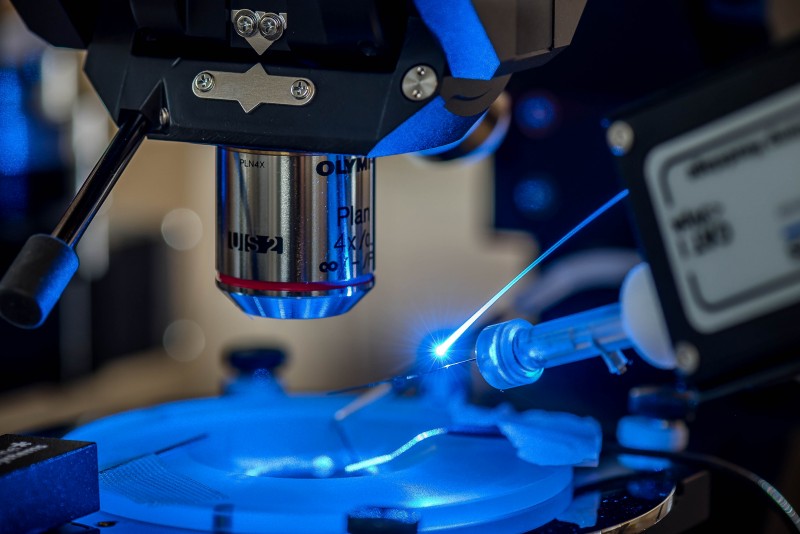
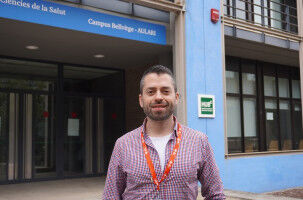
Using a technique called optogenetics, a laser light was used to turn off or on MCH neurons time locked with the temperature warming phases. It demonstrated the necessity of the MCH neurons to increase REM sleep during warming toward ’just right’ room temperature. Picture: Pascal Gugler for Insel Gruppe AG
It has been a mystery why REM sleep, or dream sleep, increases when the room temperature is "just right". Neuroscientists from Bern show that melanin-concentrating hormone neurons within the hypothalamus increase REM sleep when the need for body temperature defense is minimized, such as when sleeping in a warm and comfortable room temperature. These data have important implications for the function of REM sleep. Every night while sleeping, we cycle between two very different states of sleep. Upon falling asleep, we enter non-rapid eye movement (non-REM) sleep where our breathing is slow and regular and movement of our limbs or eyes are minimal. Approximately 90 minutes later, however, we enter rapid eye movement (REM) sleep. This is a paradoxical state where our breathing becomes fast and irregular, our limbs twitch, and our eyes move rapidly. In REM sleep, our brain is highly active, but we also become paralyzed and we lose the ability to thermoregulate or maintain our constant body temperature. "This loss of thermoregulation in REM sleep is one of the most peculiar aspects of sleep, particularly since we have finely-tuned mechanisms that control our body temperature while awake or in non-REM sleep", says Markus Schmidt of the Department for BioMedical Research (DBMR) of the University of Bern, and the Department of Neurology, Inselspital, Bern University Hospital. On the one hand, the findings confirm a hypothesis proposed earlier by Schmidt, senior author of the study, and on the other hand represent a breakthrough for sleep medicine. The paper was published in "Current Biology" and highlighted by the editors with a comment. A control mechanism saving energy
TO READ THIS ARTICLE, CREATE YOUR ACCOUNT
And extend your reading, free of charge and with no commitment.