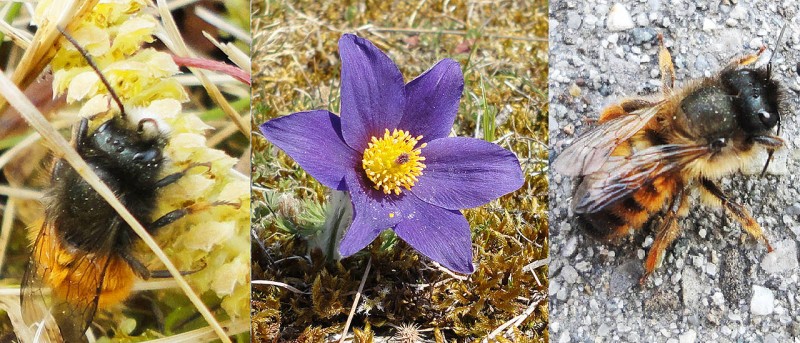
Global warming can disrupt the mutualistic interactions of plants and pollinators as in the case of the European orchard bee, the red mason bee and the pasque flower. (Image: Universität Würzburg / Sandra Kehrberger)
07/18/2019 - Plants rely on bees for pollination; bees need plants to supply nectar and pollen. Scientists from the University of Würzburg have studied how climate change affects these mutualistic interactions. Higher mean temperatures as associated with climate change can have a severe impact on plants and animals by disrupting their mutually beneficial relationship: The pasque flower ( Pulsatilla vulgaris ), for example, is very sensitive to rising temperatures by flowering earlier each year, whereas one of its major pollinators, a solitary bee species, does not quite keep pace by hatching earlier. In the worst case, this may cause the seed production of the plant to decrease and impair reproduction while requiring the bee to switch to other plants to forage on to compensate for the lack of food supply. This is the key finding of a new study conducted by scientists from the University of Würzburg which has been published in the journal Plos One . Dr. Andrea Holzschuh from the Department of Animal Ecology and Tropical Biology (Zoology III) and PhD student, Sandra Kehrberger, were in charge of the study. The times of flowering and hatching must coincide "We studied the impact of temperature on two solitary bee species that emerge in spring and on Pulsatilla vulgaris , one of the earliest flowering plants," Sandra Kehrberger describes their experiment.
TO READ THIS ARTICLE, CREATE YOUR ACCOUNT
And extend your reading, free of charge and with no commitment.