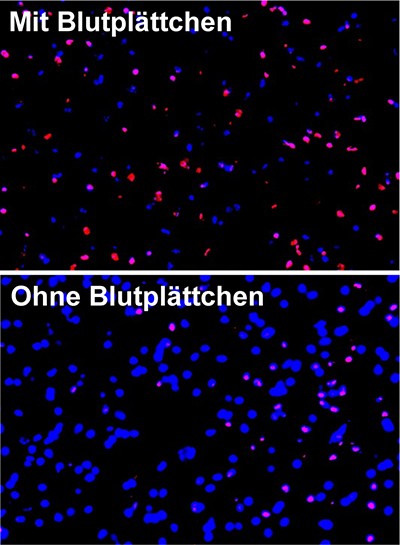
Nach einem Schlaganfall lösen Blutplättchen ein Selbstmordprogramm (Apoptose) in Nervenzellen aus, und die Nervenzellen sterben ab (links). Die untergehenden Nervenzellen sind rot gefärbt, die Zellkerne gesunder Nervenzellen erscheinen blau. Entfernt man die Blutplättchen vor dem Schlaganfall, gehen deutlich weniger Nervenzellen in den Selbstmordmodus (rechts). (Bilder: Peter Kraft / Christoph Kleinschnitz)
Platelets play a key role in strokes: They can even drive nerve cells in the brain into a kind of suicide mode, as scientists from the University of Würzburg now report in the journal "Blood". A stroke typically develops as follows: A blood vessel supplying the brain with vital oxygen and nutrients is blocked by a blood clot, resulting in nerve cell death. Signs and symptoms of a stroke can include inability to move and speech problems. Platelets are a major constituent of these blood clots. They are small cell fragments that circulate in the blood vessels whose function is to stop bleeding and close wounds. "Scientists have suspected platelets to play an important role in the development of strokes for quite some time. But their exact function was unknown until recently," says Professor Christoph Kleinschnitz, head of the Stroke Unit of the Department of Neurology of the Würzburg University Hospital.
TO READ THIS ARTICLE, CREATE YOUR ACCOUNT
And extend your reading, free of charge and with no commitment.