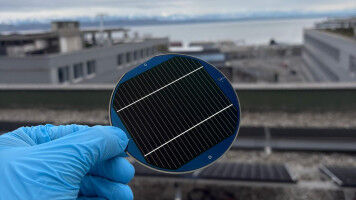
Empa researcher Gilberto Siqueira demonstrates the newly printed nanocellulose circuit. After a subsequent drying, the material can be further processed. Image: Empa
Physiological parameters in our blood can be determined without painful punctures. Empa researchers are currently working with a Canadian team to develop flexible, biocompatible nanocellulose sensors that can be attached to the skin. The 3D-printed analytic chips made of renewable raw materials will even be biodegradable in future. The idea of measuring parameters that are relevant for our health via the skin has already taken hold in medical diagnostics. Diabetics, for example, can painlessly determine their blood sugar level with a sensor instead of having to prick their fingers. Empa researchers, together with scientists from Canada, have now produced a novel flexible sensor that lies on the skin surface and is biocompatible because it is made of nanocellulose. Nanocellulose is an inexpensive, renewable raw material, which can be obtained in form of crystals and fibers, for example from wood.
TO READ THIS ARTICLE, CREATE YOUR ACCOUNT
And extend your reading, free of charge and with no commitment.