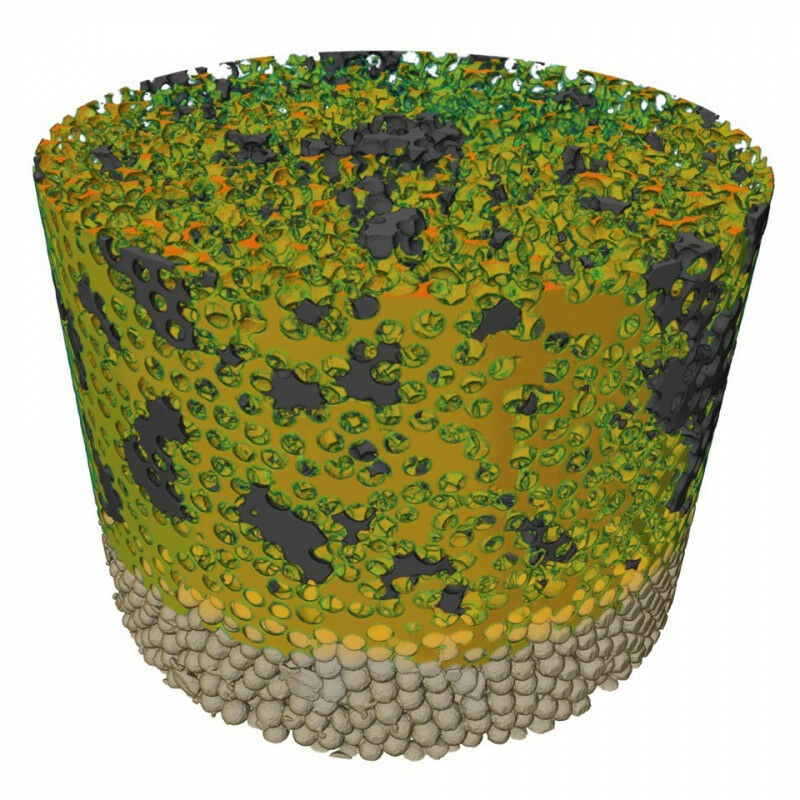
Researchers at the University of Stuttgart use high-resolution X-ray tomography to make transport processes in partially saturated porous media visible for [Picture: SFB 1313]
Researchers at the University of Stuttgart use high-resolution X-ray tomography to make transport processes in partially saturated porous media visible for [ Picture: SFB 1313] How pollutants spread in so-called partially saturated porous media - for example in sand or gravel - is difficult to compute due to the complex processes involved. A team led by Holger Steeb, Head of Research in the SimTech Cluster of Excellence as well as in the Collaborative Research Center 1313 of the University of Stuttgart, has now been able to visualize solute transport in the pore space using high-resolution synchrotron-based X-ray tomography. The renowned scientific journal PNAS reported on this*. Transport processes in porous media play an extremely important role in a variety of technical applications. Either a single fluid (liquids or gases) can flow through the pores in a solid body - in this case, we speak of fully saturated porous media - or a phase mixture such as gas/oil and water. The latter, so-called partially saturated porous media, occur very often in practice, for example in near-surface sand and gravel soils, in gas and oil deposits, and in geothermal reservoirs. If now - for example due to an environmental disaster - contaminants get into the subsoil, it is relatively easy to compute how they spread in fully saturated porous media.
TO READ THIS ARTICLE, CREATE YOUR ACCOUNT
And extend your reading, free of charge and with no commitment.