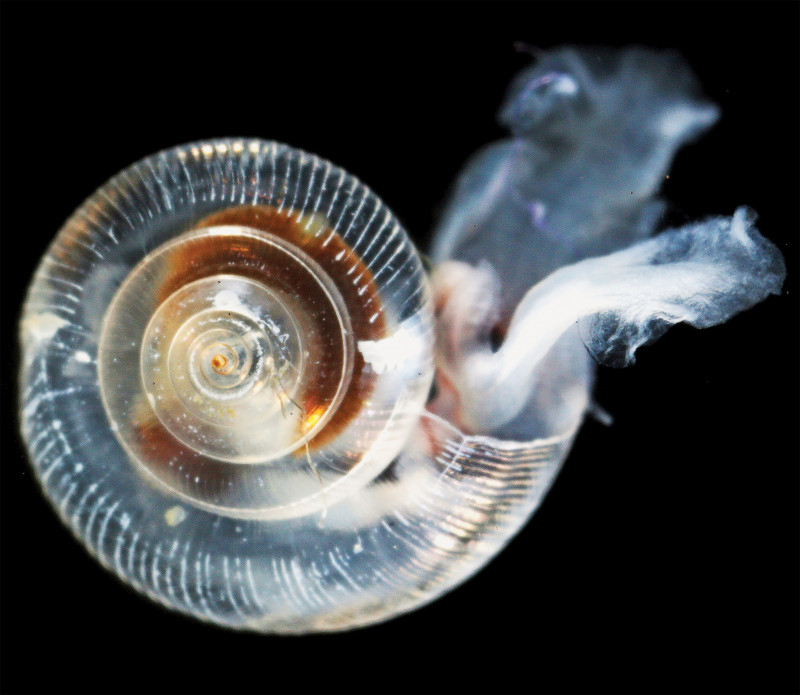
 This pteropod, or ’sea butterfly’, a type of marine snail, shows damage to its shell (jagged line radiating from center) due to acidic ocean waters.
This pteropod, or 'sea butterfly', a type of marine snail, shows damage to its shell (jagged line radiating from center) due to acidic ocean waters. National Oceanic and Atmospheric Administration NOAA - The Arctic Ocean will take up more CO2 over the 21st century than predicted by most climate models. This additional CO2 causes a distinctly stronger ocean acidification. These results were published in a study by climate scientists from the University of Bern and École normale supérieure in Paris. Ocean acidification threatens the life of calcifying organisms - such as mussels and "sea butterflies" - and can have serious consequences for the entire food chain. The ocean takes up large amounts of man-made CO
2 from the atmosphere. This additional CO
2 causes ocean acidification, a process that can already be observed today.
TO READ THIS ARTICLE, CREATE YOUR ACCOUNT
And extend your reading, free of charge and with no commitment.
Your Benefits
- Access to all content
- Receive newsmails for news and jobs
- Post ads