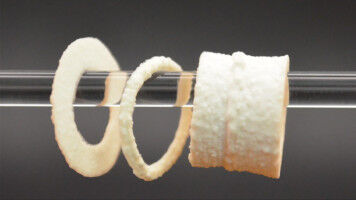
Biomorphic batteries could provide 72x more energy for robots
Like biological fat reserves store energy in animals, a new rechargeable zinc battery integrates into the structure of a robot to provide much more energy, a team led by the University of Michigan has shown. This approach to increasing capacity will be particularly important as robots shrink to the microscale and below-scales at which current stand-alone batteries are too big and inefficient. "Robot designs are restricted by the need for batteries that often occupy 20% or more of the available space inside a robot, or account for a similar proportion of the robot's weight,” said Nicholas Kotov, the Joseph B. and Florence V. Cejka Professor of Engineering, who led the research. Applications for mobile robots are exploding, from delivery drones and bike-lane take-out bots to robotic nurses and warehouse robots. On the micro side, researchers are exploring swarm robots that can self-assemble into larger devices. Multifunctional structural batteries can potentially free up space and reduce weight, but until now they could only supplement the main battery. "No other structural battery reported is comparable, in terms of energy density, to today's state-of-the-art advanced lithium batteries.