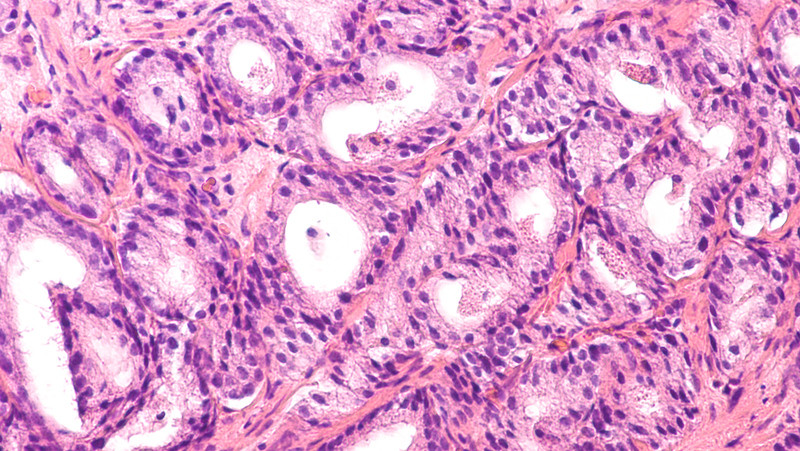
 Prostate cancer: Adenocarcinoma before developing resistance
Prostate cancer: Adenocarcinoma before developing resistance © Insel Gruppe - A number of types of cancer are prone to adapt to targeted treatment, enabling resistance. Prof. Mark Rubin, Department for BioMedical Research and Bern Center for Precision Medicine, together with colleagues from the Weill Cornell Medicine and the University of Manchester have now published a 'Perspective' in the journal Molecular Cell. Using two different types of cancer as examples, they explore the challenges of a resistance with the goal of diminishing the most aggressive forms of cancer. The paper shows the importance of carrying out cancer research that is networked and coordinated across disciplines, as explained by the Tumorzentrum Bern (University Cancer Center Inselspital, UCI). A new publication from the Department for Biomedical Research and the Bern Center for Precision Medicine at the University of Bern and Inselspital, University Hospital Bern explains the fundamental science behind the development of resistance in various types of cancers. It discusses the established and potential roles of epigenetic, genomic, and microenvironmental perturbations as drivers of resistance. Furthermore the authors stipulate that a better understanding of the interplay of these drivers may be necessary to devise better therapeutic approaches for both de novo and targeted therapy-associated small cell lung and prostate cancers.
TO READ THIS ARTICLE, CREATE YOUR ACCOUNT
And extend your reading, free of charge and with no commitment.
Your Benefits
- Access to all content
- Receive newsmails for news and jobs
- Post ads