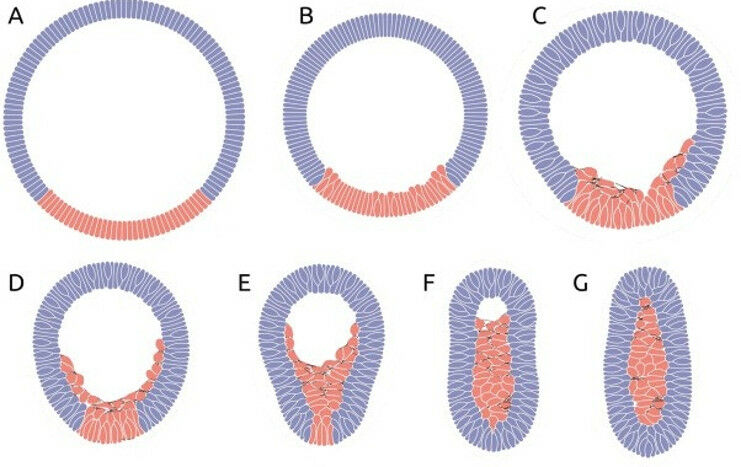
Simulated gastrulation by ingression. In the first picture the gastrulation starts as soon as the cells are organized in a hollow sphere (the blastula). In the last picture the fully gastrulated embryo is shown (red is the future endodermal tissue and blue the ectodermal tissue).
Simulated gastrulation by ingression. In the first picture the gastrulation starts as soon as the cells are organized in a hollow sphere (the blastula). In the last picture the fully gastrulated embryo is shown (red is the future endodermal tissue and blue the ectodermal tissue). Computational biologists from the University of Amsterdam have succeeded in making a computer model of one of the most essential steps in the embryonic development of Cnidaria. They modeled the process of gastrulation, during which two types of tissue arise: the tissue that will later form the internal organs, and the tissue that will form the skin and senses. The work, a graduation project by Maarten van der Sande supervised by Jaap Kaandorp, was published in Developmental Biology on 12 January. Many biologists regard gastrulation as the most important step in the developmental biology of animals.
TO READ THIS ARTICLE, CREATE YOUR ACCOUNT
And extend your reading, free of charge and with no commitment.