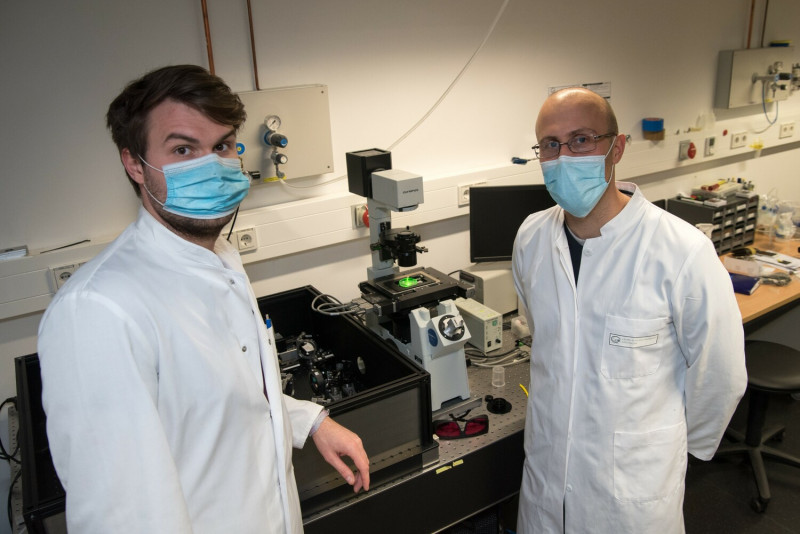
Detecting pathogens without taking samples: this could be possible in the future with carbon nanotubes developed by a team led by Sebastian Kruß (right) and Robert Nißler. Photo: Alexander Spreinat
Detecting pathogens without taking samples: this could be possible in the future with carbon nanotubes developed by a team led by Sebastian Kruß ( right ) and Robert Nißler. Photo: Alexander Spreinat Luminous carbon nanotubes detect pathogens - and are quick and easy to use. Researchers from Bochum, Göttingen, Duisburg and Cologne have developed a new method for detecting bacteria and infections. They use fluorescent nanosensors to track down pathogens faster and more easily than with established methods. A team headed by Professor Sebastian Kruß, formerly at Universität Göttingen, now at Ruhr-Universität Bochum (RUB), describes the results Communications, published online on 25 November 2020. Traditional methods of detecting bacteria require tissue samples to be taken and analysed. Sebastian Kruß and his team hope to eliminate the need to take samples by using tiny optical sensors to visualise pathogens directly at the site of infection.
TO READ THIS ARTICLE, CREATE YOUR ACCOUNT
And extend your reading, free of charge and with no commitment.