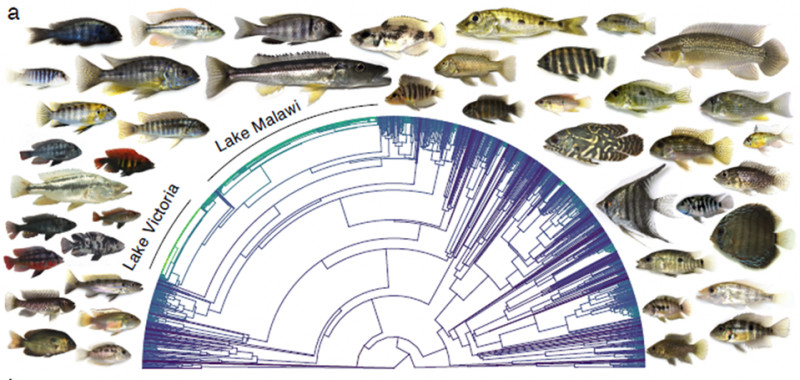
The graphic shows the chronological history of the development of all 1712 cichlid species scientifically described, true to scale. The superfast radiations of Lake Victoria and Lake Malawi are marked in green. The photos give an impression of the morphological diversity of the cichlids. Graphic: Matthew McGee et a., Nature 2020
The graphic shows the chronological history of the development of all 1712 cichlid species scientifically described, true to scale. The superfast radiations of Lake Victoria and Lake Malawi are marked in green. The photos give an impression of the morphological diversity of the cichlids. Graphic: Matthew McGee et a. Nature 2020 - Using genomic analyses of 100 cichlid species, scientists from Eawag and the University Bern, together with co-workers in Australia, the UK, Tanzania, Uganda and the US, have investigated the striking variation observed in cichlid fish speciation rates. Their findings show that exchanges of genetic variants between existing species dramatically accelerate the development of new species - given favourable ecological conditions. Evolution depends on genetic mutations: if numerous random mutations accumulate in a population, a new species may emerge. Speciation of this kind takes millions of years.
TO READ THIS ARTICLE, CREATE YOUR ACCOUNT
And extend your reading, free of charge and with no commitment.