Illustration by Dilip Asthagiri
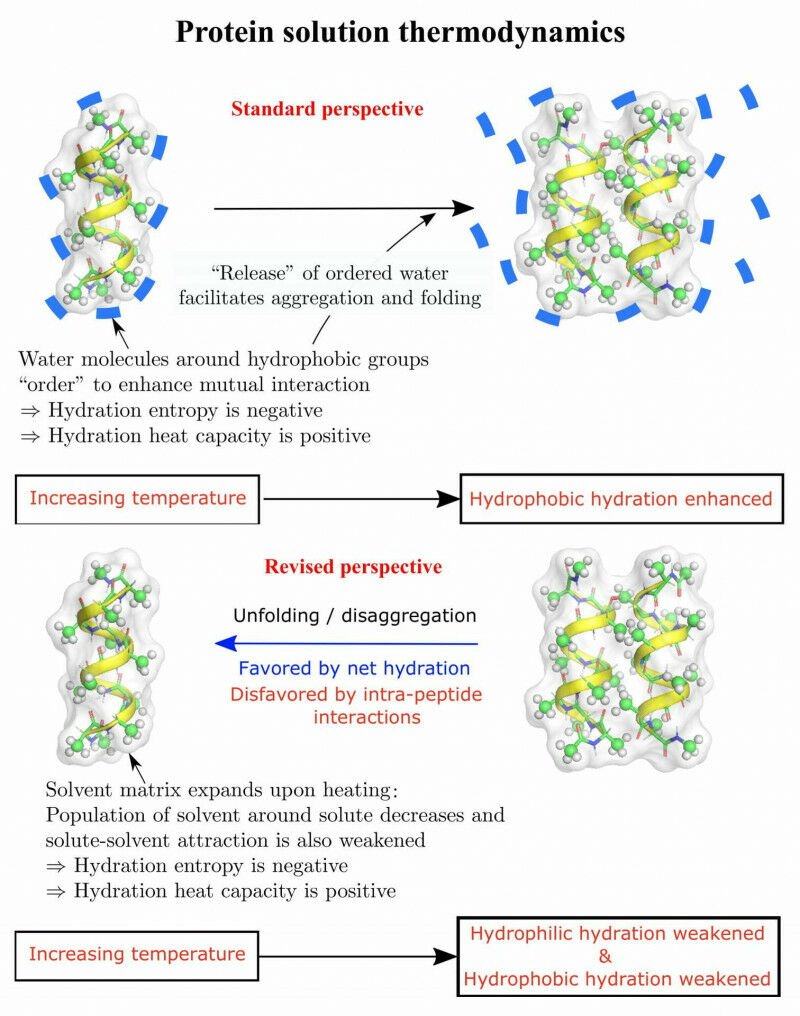
Illustration by Dilip Asthagiri - Atom-scale models could help refine established theories on how proteins interact with solutions It's a long-standing assumption that the presence of water influences how proteins fold. A new study is challenging the details. A paper in the American Chemical Society's Journal of Physical Chemistry Letters shows proteins that presumably evolved to avoid water as they fold may actually behave in ways scientists did not anticipate. That discovery could change how scientists think about hydrophobic (water-avoiding) and hydrophilic (water-attracting) interactions in solutions, according to a Rice University engineer. Collaborators from Rice and Tulane universities and the Johns Hopkins University School of Medicine created atom-level models of polypeptides that showed folding is also influenced by thermal expansion of the solvents they occupy, but not in ways that match previous assumptions. The long-held view is that hydrophobic amino acids, which avoid water by coming together as efficiently as possible, are a dominant force in protein folding, said Dilip Asthagiri , an associate research professor of chemical and biomolecular engineering at Rice's Brown School of Engineering. The new study shows temperature, a factor not always included in protein folding models, also influences the phenomenon.
TO READ THIS ARTICLE, CREATE YOUR ACCOUNT
And extend your reading, free of charge and with no commitment.