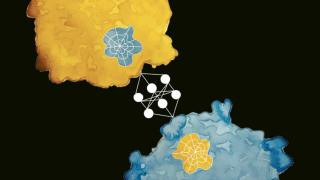
Detail of the Nature Methods cover (original image by Laura Persat, EPFL)
Detail of the Nature Methods cover (original image by Laura Persat, EPFL) - Traditional methods for predicting interactions between proteins and other molecules rely on complex supercomputer simulations. Instead, a group of researchers from EPFL and USI developed a new artificial intelligence system that analyzes the 3D structure of protein surfaces. The new method MaSIF (Molecular Surface Interaction Fingerprinting) is a collaboration between the EPFL Protein Design & Immunoengineering lab (headed by Prof. Bruno Correia) and the group of Michael Bronstein , professor at USI and Imperial College of London, and head of research in Graph Learning at Twitter. The work appeared on the cover of the February issue of the prestigious scientific. Proteins are among the most important biomolecules in nature, the "building blocks" of life responsible for a vast array of functions in living organisms. Proteins comprise chains of small molecules called aminoacids; these chains are folded into complex three-dimensional structures under the effect of electrostatic forces. The structure of proteins determines their function, namely how they interact with other biomolecules. Understanding these interactions is key for the development of drugs, which are typically designed to bind to a protein target. Through the innovative machine learning technique developed by Prof. Bronstein, called geometric deep learning , the researchers were able to link the geometric and chemical properties of proteins with their ability to interact.
TO READ THIS ARTICLE, CREATE YOUR ACCOUNT
And extend your reading, free of charge and with no commitment.