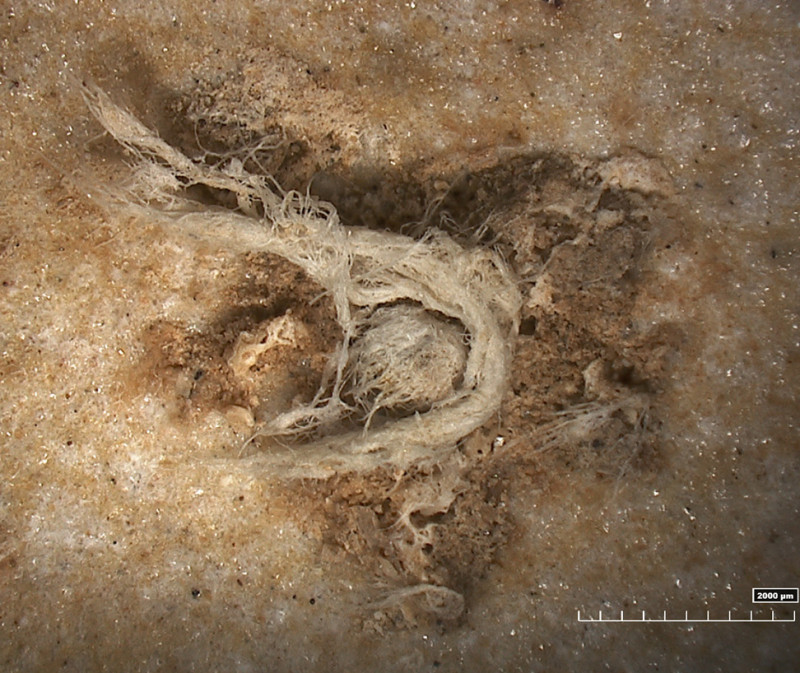
 Photograph of the cord fragment taken by digital microscopy (the fragment is approximately 6.2 mm long and 0.5 mm wide).
Photograph of the cord fragment taken by digital microscopy (the fragment is approximately 6.2 mm long and 0.5 mm wide). C2RMF - Contrary to popular belief, Neanderthals were no less technologically advanced than Homo sapiens . An international team, including researchers from the CNRS, have discovered the first evidence of cord making, dating back more than 40,000 years 1 , on aflint fragment from the prehistoric site of Abri du Maras in the south of France 2 . Microscopic analysis showed that these remains had been intertwined, proof of their modification by humans. Photographs revealed three bundles of twisted fibres, plied together to create one cord. In addition, spectroscopic analysis revealed that these strands were made of cellulose, probably from coniferous trees. This discovery highlights unexpected cognitive abilities on the part of Neanderthals, who not only had a good understanding of the mathematics involved in winding the fibres, but also a thorough knowledge of tree growth.
TO READ THIS ARTICLE, CREATE YOUR ACCOUNT
And extend your reading, free of charge and with no commitment.
Your Benefits
- Access to all content
- Receive newsmails for news and jobs
- Post ads