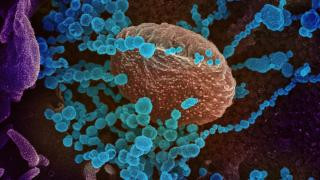
Scanned electron microscope image of the novel Coronavirus SARS-CoV-2 (photo: NIAID-RML, via flickr)
Scanned electron microscope image of the novel Coronavirus SARS-CoV-2 (photo: NIAID-RML, via flickr) - After the announcement, in May, of the first results of serological tests carried out on healthcare personnel in Ticino [ www.usi.ch/en/feeds/13622 ], significant data on the antibody response to SARS-CoV-2 is now available, thanks to the analysis carried out - among others - by the Institute for Research in Biomedicine (IRB, affiliated to USI) and Humabs BioMed (subsidiary of Vir Biotechnology), in close collaboration with hospitals and COVID-19 centers in Ticino (Ente Ospedaliero Cantonale EOC and Clinica Luganese Moncucco). The results of the study were published 'online first' in the peer-reviewed journal Cell . Results of this study, based on blood samples from nearly 650 SARS-CoV-2 infected individuals in Switzerland, Italy and the United States, show that the magnitude of antibodies produced by an infected individual is proportional to disease severity (with hospitalised patients possessing higher antibody titers compared to non-hospitalised patients), and that those antibodies have a half-life of less than two months. The researchers also report that the receptor binding domain (RBD) of the virus is the main target of naturally occurring neutralizing antibodies, accounting for 90% of the neutralizing activity in serum. The study provides new information about the diverse individual antibody response to SARS-CoV-2 infection, and the results establish a blueprint that could help guide future serology studies and inform vaccine and therapeutic design strategies.
TO READ THIS ARTICLE, CREATE YOUR ACCOUNT
And extend your reading, free of charge and with no commitment.