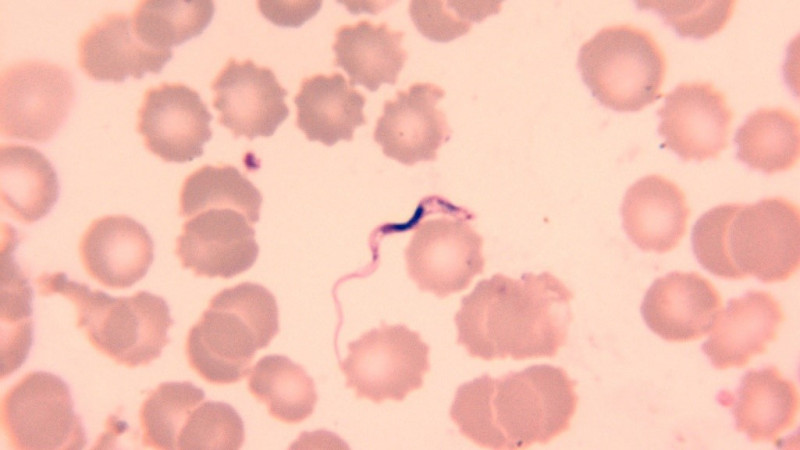
Trypomastigote torm of Trypanosoma brucei rhodesiense/gambiense. Photo credit: Swiss TPH
Trypomastigote torm of Trypanosoma brucei rhodesiense/gambiense. Photo credit: Swiss TPH - Human African trypanosomiasis, also known as HAT or sleeping sickness, is a vector-borne parasitic disease. Since the number of new cases reported between 2000 and 2018 dropped by 95%, the World Health Organization (WHO) targeted its elimination as a public health problem by 2020 and interruption of transmission (zero cases) for 2030; but there is still much work to be done. A special issue in the journal Tropical Medicine and Infectious Diseases, edited by Christian Burri from Swiss TPH, addresses what has been achieved in regards to sleeping sickness elimination, and what could still get in the way. Sleeping sickness is a vector-borne parasitic disease caused by infection with protozoan parasites belonging to the genus Trypanosoma. They are transmitted to humans by bites of tsetse flies that have been infected from humans or animals harbouring human pathogenic parasites. Tsetse flies are only found in sub-Saharan Africa; rural populations living in regions where transmission occurs and which depend on agriculture, fishing or hunting are the most exposed to the tsetse fly and thus, the disease.
TO READ THIS ARTICLE, CREATE YOUR ACCOUNT
And extend your reading, free of charge and with no commitment.