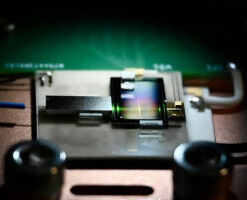
 This photo shows the fabrication procedure of a nondiffracting of a lightfield using a desired transversed caustic.
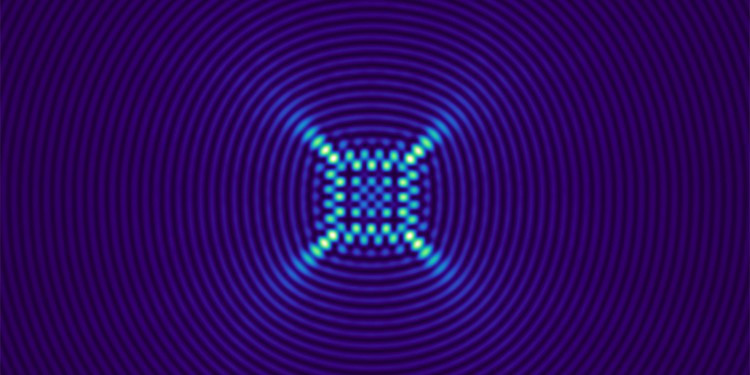
This photo shows the fabrication procedure of a nondiffracting of a lightfield using a desired transversed caustic. WWU - Alessandro Zannotti Researchers develop for the first time light fields using caustics that do not change during propagation / Study in "Nature Communications" Modern applications as high resolution microsopy or microor nanoscale material processing require customized laser beams that do not change during propagation. This represents an immense challenge since light typically broadens during propagation, a phenomenon known as diffraction. So-called propagation-invariant or non-diffracting light fields therefore do not seem possible at first glance. If it were possible to produce them, they would enable new applications such as light disk microscopy or laser-based cutting, milling or drilling with high aspect ratios. An international research team from the Universities of Birmingham, Marseille and Münster has now succeeded for the first time to create arbitrary nondiffracting beams. "We implement an approach inspired by nature, in which any desired intensity structure can be specified by its boundaries," explains one of the authors of the study, Prof. Cornelia Denz from the Institute of Applied Physics at the University of Münster.
TO READ THIS ARTICLE, CREATE YOUR ACCOUNT
And extend your reading, free of charge and with no commitment.
Your Benefits
- Access to all content
- Receive newsmails for news and jobs
- Post ads