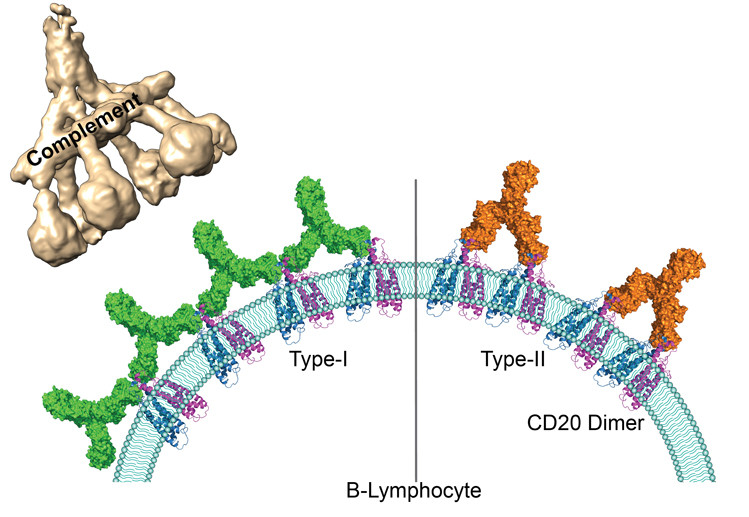
 Les antigènes CD20 humains (en rose et bleu) exprimés à la surface des lymphocytes B sont reconnus par les anticorps thérapeutiques de type 1 (en vert) et de type 2 (en orange). Seuls les anticoprs de type 1 ont la capacité de recruter la partie C1 du complément et ainsi d’activer la « voie du complément ».
Les antigènes CD20 humains (en rose et bleu) exprimés à la surface des lymphocytes B sont reconnus par les anticorps thérapeutiques de type 1 ( en vert ) et de type 2 ( en orange ). Seuls les anticoprs de type 1 ont la capacité de recruter la partie C1 du complément et ainsi d'activer la « voie du complément ». Nicolas Reyes - Since the late 1990s, immunotherapy has been the frontline treatment against lymphomas where synthetic antibodies are used to stop the proliferation of cancerous white blood cells. However, in the more than 20 years since their use began, the molecular mechanisms that underlie this therapy are still little understood. For the first time, scientists from the CNRS, Institut Pasteur and Université de Bordeaux have observed the interaction between therapeutic antibodies and their target protein. The research, published in Science on 14 August 2020, describes these molecular mechanisms and opens the way to the development of new treatments. Non-Hodgkin lymphomas are among the most common cancers affecting almost 1.5 million people globally.
TO READ THIS ARTICLE, CREATE YOUR ACCOUNT
And extend your reading, free of charge and with no commitment.
Your Benefits
- Access to all content
- Receive newsmails for news and jobs
- Post ads