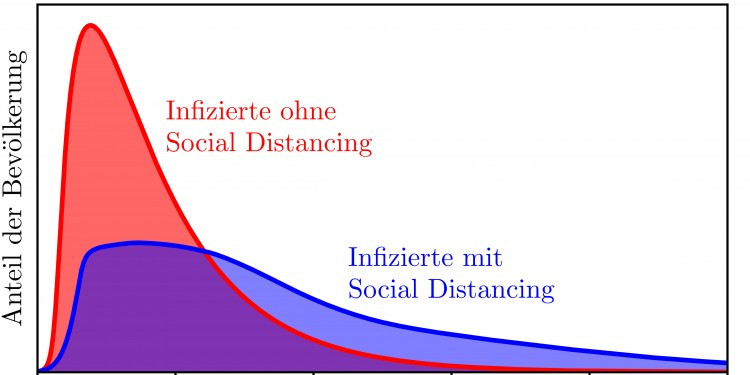
 Simulations based on a new model for the spread of epidemics show the decrease in infection rates as a result of social distancing.
Simulations based on a new model for the spread of epidemics show the decrease in infection rates as a result of social distancing. M. te Vrugt et al./Nature Research Scientists worldwide have been working flat out on research into infectious diseases in the wake of the global outbreak of the COVID-19 disease, caused by the new coronavirus SARS-CoV-2. This concerns not only virologists, but also physicists, who are developing mathematical models to describe the spread of epidemics. Such models are important for testing the effects of various measures designed to contain the disease - such as face masks, closing public buildings and businesses, and the familiar one of social distancing. These models often serve as a basis for political decisions and underline the justification for any measures taken. Physicists Michael te Vrugt, Jens Bickmann and Prof. Raphael Wittkowski from the Institute of Theoretical Physics and the Center for Soft Nanoscience at the University of Münster have developed a new model showing the spread of infectious diseases. The working group led by Raphael Wittkowski is studying Statistical Physics, i.e. the description of systems consisting of a large number of particles.
TO READ THIS ARTICLE, CREATE YOUR ACCOUNT
And extend your reading, free of charge and with no commitment.
Your Benefits
- Access to all content
- Receive newsmails for news and jobs
- Post ads