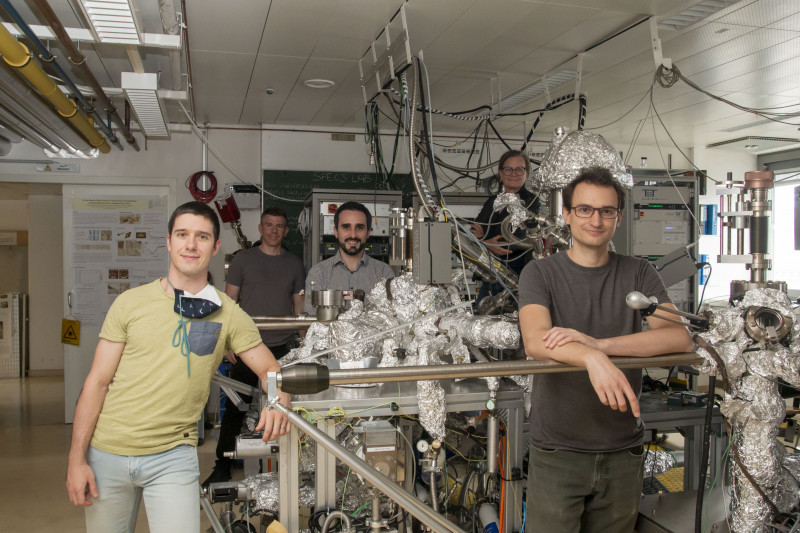
1/2 images The team at TU Wien Nikolaus Resch, Gareth Parkinson, Michele Riva, Ulrike Diebold and Florian Kraushofer (left to right) Nikolaus Resch, Gareth Parkinson, Michele Riva, Ulrike Diebold and Florian Kraushofer (left to right)
1/2 images The team at TU Wien Nikolaus Resch, Gareth Parkinson, Michele Riva, Ulrike Diebold and Florian Kraushofer ( left to right ) Nikolaus Resch, Gareth Parkinson, Michele Riva, Ulrike Diebold and Florian Kraushofer ( left to right ) - A human research team and a machine learning algorithm have found that we need to rethink much of what we know about iridium oxide. 1/2 images The team at TU Wien Nikolaus Resch, Gareth Parkinson, Michele Riva, Ulrike Diebold and Florian Kraushofer (left to right) Nikolaus Resch, Gareth Parkinson, Michele Riva, Ulrike Diebold and Florian Kraushofer (left to right) 1/2 images A glimpse of the experiment Vacuum chamber at TU Wien Vacuum chamber at TU Wien Iridium oxide is an excellent catalyst for electrochemical reactions, and is typically used for the production of energy carriers such as hydrogen from water. Now it turns out that research on iridium oxide carried out so far has been based on a wrong basic assumption: The arrangement of the atoms on its surface is completely different to that previously assumed. The way in which this surprising result was determined gives a tantalizing first glimpse of how research might be performed in the future: a collaborative effort between a human research team and artificial intelligence analyzed the same problem, and came to the same conclusion. Since the researchers at the TU Wien and the TU Munich reached the same result at the same time, they published their findings jointly in the journal "Physical Review Letters".
TO READ THIS ARTICLE, CREATE YOUR ACCOUNT
And extend your reading, free of charge and with no commitment.