In late March, representatives of government and the business and scientific communities will meet on the University of Bonn’s Poppelsdorf Campus to discuss one of the most pressing issues of today’s digital age: the targeted dissemination of disinformation. The Bonn Dialogue on Cybersecurity will be held on Thursday, March 26, 2026, from 5:30 pm to 8:30 pm in Lecture Hall 1, Poppelsdorf Campus, University of Bonn, Friedrich-Hirzebruch-Allee 5, 53115.
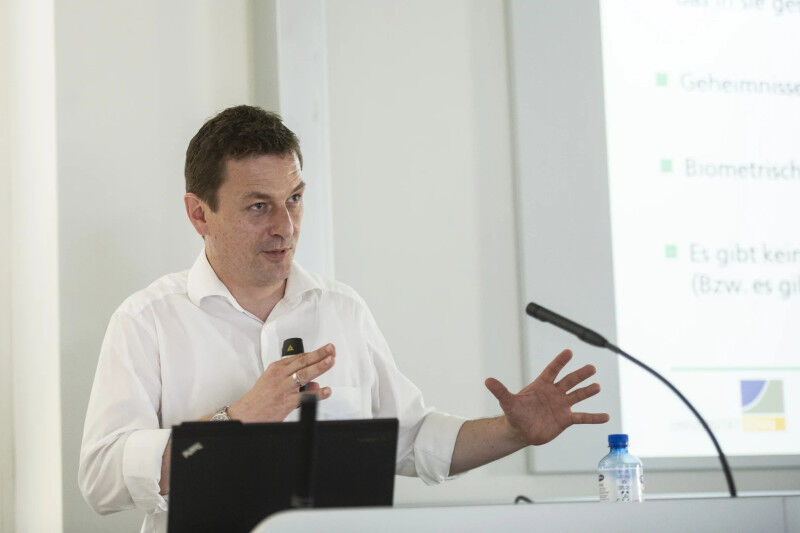
The topic is of major social relevance, as disinformation is deliberately disseminated, spreads quickly in the digital space and in many cases has a large influence on public debate, democratic processes and trust in institutions. Professor Michael Meier of the University of Bonn says: "To effectively combat disinformation, we must unite technical knowledge with social perception and political responsibility, and that is what the Bonn Dialogue on Cybersecurity is all’about." A number of practical tips from Professor Meier on how to better distinguish fact from fiction online are provided at the end of this press release.
The Bonn Dialogue on Cybersecurity is exemplary as an approach of incorporating transdisciplinary research expertise when addressing social and security policy issues. Transdisciplinarity indeed means different disciplines engaging in a dialogue that integrates practical considerations and is a core part of the concept for the future of the University of Bonn as a University of Excellence.
High-caliber speakers
The event opens with a keynote address by General Staff Colonel Sönke Marahrens, head of department at the Center for Digitalization of the Bundeswehr, who will talk about security policy in regard to disinformation and hybrid threats in the digital space.
The panel discussion following will further illuminate various aspects surrounding the issue, the experts including Dr. Rüdiger Peusquens, who, as member of the greater management board of Deutsche Telekom Security, will be representing the IT security industry, and Alena Epifanova, Research Fellow at the German Council on Foreign Relations (DGAP), who will be providing a foreign and security policy perspective. Silvia Stöber, Senior Reporter at CORRECTIV, will be contributing her views regarding the journalistic handling of disinformation.
Michael Meier, who is Professor for Computer Science at the University of Bonn and head of the Cyber Security department at the Fraunhofer Institute for Communication, Information Processing and Ergonomics (FKIE), will be moderating the discussion and establishing a link between research, practice and policy.
For additional information on the event and to register, please visit https://www.fkie.fraunhofer.de/bdcs.
An overview of all previous events as part of the Bonn Dialogue on Cybersecurity is provided at https://www.fkie.fraunhofer.de/de/Veranstaltungen/bonner-dialog-fuer-cybersicherheit.html.
Questions can be submitted during the event or in advance by email to kontakt@fkie.fraunhofer.de.
The Bonn Dialogue on Cybersecurity (BDCS)
Cybersecurity experts discuss controversial issues and current challenges relating to cybersecurity. This well-established, free-admission event series is backed by the Federal City of Bonn, Deutsche Telekom, Fraunhofer FKIE, the Bonn/Rhein-Sieg Chamber of Industry and Commerce (IHK), the Alliance for Cybersecurity, the University of Bonn, HiSolutions AG and Cyber Security Cluster Bonn e. V. and promotes local and supra-regional networking as a secondary objective. The 24th BDCS will be held in March 2026.
Five expert tips for identifying fake news on the Internet
1. Check first who published the information.
Professor Meier recommends: "Look at the relevant website, account or medium behind a given claim or assertion. Is the source known, reputable and transparent? If it is unclear who is behind it, caution is advised."
2. Don’t just believe headlines.
"Sensationalist headlines are frequently used in fake news stories. Read the entire text and consider whether the headline really relates to the content. The headline often exaggerates or oversimplifies matters."
3. Look for a second reliable source.
"Real news spreads quickly nowadays. If something truly important or spectacular is going on, other reputable media outlets will generally be reporting on it too. But if you only find claims being made in one place, that’s a warning sign."
4. Note the date and evaluate images and context.
"In many cases content is taken out of context rather than being entirely fabricated. An old photo may be shown that is supposed to be of a recent occurrence. You should thus always check when a report was published and whether the image is actually connected to the statements made. Also: As AI image generation increasingly improves, images alone cannot be taken as proof."
5. Be especially suspicious when strong emotions are triggered.
Professor Meier recommends: "Fake content is often designed to shock, anger or frighten so that the reader or viewer will quickly share it around without much thought. It’s a good idea to then pause and check the information before believing, commenting on or sharing it."